Pastured Pork
Sus scrofa domesticus · also known as pasture-raised pork, pastured pig, heritage pork, free-range pork, outdoor-raised pork, pork loin, pork tenderloin
By Superfoods Advisor Editors·July 3, 2026
Is pork good for you? Pork nutrition per 100 g, its thiamine, protein and zinc, pork vs beef, what pasture-raising changes, and processed-meat cautions.
Pork, the meat of the domestic pig (Sus scrofa domesticus), is a nutritious protein when eaten fresh and lean: 100 g of roasted lean loin provides about 26–29 g of complete protein and 0.95–1.0 mg of thiamine (vitamin B1), more than any other common meat. Processed pork such as bacon and ham is a different case, classed by IARC as carcinogenic to humans.
Domestic pigs are descended from wild boar and have been kept as livestock since the Neolithic. Pork is one of the most widely consumed meats in the world, with China, the European Union, and the United States as the largest producers and consumers. Modern commercial pork production takes place overwhelmingly in intensive confinement facilities; “pastured pork” or “pasture-raised pork” refers to pigs given meaningful outdoor access to pasture or woodland, enabling natural foraging behaviors including rooting, grazing, and consumption of a varied diet beyond grain-based rations. Welfare certifications differ, and not all of them require outdoor access for pigs; for example, Certified Animal Welfare Approved by A Greener World requires continuous access to a ranging and foraging area for all pigs from 21 days of age (A Greener World, pig standards).
From a nutritional standpoint, pork occupies a distinctive niche among common meats: it is the most concentrated source of thiamine (vitamin B1) among commonly consumed animal foods, and provides complete protein with a high amino acid score alongside meaningful quantities of zinc, selenium, niacin, B6, and B12. Pastured pigs, which have access to sunlight, varied forage, and insects, can produce pork with somewhat more polyunsaturated fat and, under adequate UV exposure, higher vitamin D content — compared to conventional confinement-raised pork. This entry covers the nutritional profile of pork with particular emphasis on pastured production, the evidence for health-relevant differences, key safety considerations, and practical preparation guidance.
Evidence at a glance
Pork vs. Beef
Pork and beef are both red meats with complete protein, but they differ in micronutrients: lean pork carries far more thiamine, while beef carries more zinc, iron and vitamin B12. Lean pork tenderloin (about 143 kcal per 100 g roasted) is closer to skinless chicken breast in calories than to most beef cuts.
| Per 100 g, cooked | Lean pork loin | Beef |
|---|---|---|
| Thiamine (B1) | ~0.95–1.0 mg | ~0.08 mg (roasted lean) |
| Zinc | ~2.4–2.5 mg | ~6.3 mg (85% lean ground) |
| Iron | ~1.1–1.3 mg | ~2.6 mg (85% lean ground) |
| Vitamin B12 | ~0.55–0.73 µg | ~2.6 µg (85% lean ground) |
Pork figures are the USDA values cited on this page; beef zinc, iron and B12 figures come from the grass-fed beef entry, which uses USDA’s broiled 85% lean ground beef. Cancer and heart-disease findings for unprocessed red meat apply to both.
Active Compounds and Nutritional Profile
Pork is a complete protein with an unusually high thiamine content and useful amounts of selenium, zinc, niacin and B6.
Thiamine (Vitamin B1) — pork’s defining nutritional distinction: Pork is the richest commonly consumed meat source of thiamine, containing about 0.95–1.0 mg of thiamine per 100 g of roasted lean tenderloin or whole loin (USDA FoodData Central; USDA FoodData Central) — roughly 80–85% of the 1.2 mg Daily Value. This is far higher than roasted lean beef (about 0.08 mg/100 g; USDA FoodData Central), lamb (~0.11 mg/100 g; USDA FoodData Central), or chicken breast (~0.07 mg/100 g; USDA FoodData Central). Thiamine is an essential cofactor for pyruvate dehydrogenase, alpha-ketoglutarate dehydrogenase, and transketolase — enzymes central to carbohydrate oxidation, amino acid metabolism, and the pentose phosphate pathway. Thiamine deficiency causes beriberi (peripheral neuropathy and/or cardiac failure), Wernicke’s encephalopathy (in the context of alcohol misuse), and neurological deterioration; pork is a uniquely efficient dietary source for meeting thiamine requirements.
Protein: Roasted lean pork loin and tenderloin provide approximately 26–29 g of protein per 100 g (USDA FoodData Central). Like all animal proteins, pork provides all nine essential amino acids in proportions meeting human requirements. Pork is particularly high in glutamic acid, aspartic acid, leucine, and lysine. The leucine content (~2.2–2.3 g/100 g roasted lean loin; USDA FoodData Central) supports muscle protein synthesis through mTORC1 signaling.
Zinc: Pork is a good source of bioavailable zinc, providing about 2.4–2.5 mg per 100 g of roasted lean loin (roughly 22% of the 11 mg Daily Value) and more in darker, fattier cuts such as shoulder (~3.7 mg) and spareribs (~4.6 mg) (USDA FoodData Central; USDA FoodData Central; USDA FoodData Central). Meat contains no phytate, the compound that limits zinc absorption from many plant foods.
Selenium: Roasted lean pork loin provides approximately 35–38 µg of selenium per 100 g (64–69% of the 55 µg Daily Value; USDA FoodData Central). The selenium content of pork is influenced by the selenium content of the feed or, in pastured animals, the soil and forage available to them.
Niacin (Vitamin B3): Pork is a good source of niacin, providing approximately 6–7.4 mg of preformed niacin per 100 g of roasted lean loin (USDA FoodData Central), in addition to tryptophan that can be converted to niacin at a ratio of approximately 60:1. Niacin is an essential coenzyme precursor (NAD+, NADP+) central to energy metabolism.
Vitamin B6: Approximately 0.55–0.74 mg per 100 g of roasted lean loin (32–43% of the 1.7 mg DV; USDA FoodData Central). Involved in amino acid transamination, glycogen phosphorylase activity, and neurotransmitter synthesis.
Vitamin B12: Approximately 0.55–0.73 µg per 100 g of roasted lean loin (23–30% of the 2.4 µg DV; USDA FoodData Central), supporting DNA synthesis and neurological function.
Fatty acid profile — pastured vs. conventional: Pigs are omnivores with a fatty acid composition of adipose tissue and muscle fat that closely reflects dietary fatty acid intake — more so than ruminants (cattle, sheep), whose rumen microbiome partially converts dietary polyunsaturated fats to saturated fats via biohydrogenation. This means pastured pigs, with access to grasses (rich in ALA, the plant omega-3), legumes, insects, and acorns (if available), can accumulate higher proportions of polyunsaturated fatty acids in their tissue than pigs raised on high-omega-6 corn-soy rations. A Swedish study comparing pigs reared outdoors with access to pasture against indoor-reared pigs found higher levels of polyunsaturated fatty acids and vitamin E in the intramuscular fat of the outdoor animals (Nilzén et al., 2001); a second Swedish study found outdoor rearing raised omega-3 polyunsaturated fatty acids in loin muscle only slightly, and only in entire (uncastrated) males (Högberg et al., 2004). The size of any omega-3 shift varies with breed, sex, forage, season, and supplementary feed. Absolute concentrations of EPA and DHA in pork remain modest compared to oily fish, so any contribution to dietary omega-6:omega-3 balance is likely small.
Conjugated linoleic acid (CLA): Whether pasture access meaningfully raises CLA in pork is not well established, and controlled comparisons are scarce. CLA has been studied for anti-inflammatory, anticarcinogenic, and body-composition effects, mostly in animal models, and occurs at higher concentrations in dairy and meat from ruminants. In pork, CLA levels are substantially lower than in grass-fed ruminant products, and the clinical significance of any difference between pastured and conventional pork is unclear.
Vitamin D from sunlight exposure: Pigs, like humans, synthesize vitamin D3 from 7-dehydrocholesterol in skin exposed to UV-B radiation. Pigs given regular sunlight exposure can deposit more vitamin D in their meat than pigs raised indoors under artificial light, though in one study the vitamin D3 content of their fat did not differ. A controlled study found higher vitamin D content in loin from pigs given sunlight exposure than from confinement-raised pigs (Larson-Meyer et al., 2017, PLoS One). Given widespread vitamin D insufficiency in many populations, meat that is a better dietary vitamin D source has practical nutritional relevance.
Heme iron: Pork, as a red meat, contains heme iron, which is absorbed more efficiently than the non-heme iron in plant foods. Pork provides approximately 1.1–1.3 mg of iron per 100 g cooked (USDA FoodData Central; USDA FoodData Central).
Evidence for Purported Benefits
Thiamine Sufficiency
Evidence:Moderate Pork is measured as thiamine-dense, and NHANES data link pork intake to higher thiamine intake.
Dietary thiamine recommendations (1.1–1.2 mg/day for adults) are achievable from pork consumption alone at modest serving sizes. In US NHANES 2011–2018 data, pork consumers had higher thiamine intakes than non-consumers, and a larger share of them met thiamine recommendations (Agarwal & Fulgoni, 2023). Beriberi has historically been documented in populations whose diets were dominated by polished white rice, which loses most of its thiamine when the bran is milled away. Pork is effectively thiamine-dense in a dietary context where plant thiamine sources (whole grains, legumes) may be variably available or bioavailable.
Muscle Protein Synthesis and Amino Acid Delivery
Evidence:Strong Pork is a complete protein; two crossover trials showed high amino acid availability, though not muscle growth directly.
Pork supplies all essential amino acids, including leucine, in proportions typical of high-quality animal protein. In two randomized crossover trials in young (n=30) and older (n=25) adults, a two-ounce-equivalent portion of unprocessed lean pork delivered more essential amino acids, and produced greater postprandial essential amino acid availability in blood, than the same ounce-equivalent portions of eggs, black beans, or almonds (Connolly et al., 2023, Nutrients). These trials measured amino acid availability rather than muscle protein synthesis or lean mass directly.
Fatty Acid Profile Differences — Pastured vs. Conventional
Evidence:Lab & animal only Analyses show more polyunsaturated fat in outdoor-reared pork; no human outcome trials exist.
Analytical studies have documented measurable differences in the fatty acid profiles of pork from pigs with outdoor or pasture access versus confinement-raised pigs, generally showing higher proportions of polyunsaturated fatty acids in the outdoor-reared meat. These differences are plausible mechanistically — pigs’ direct incorporation of dietary fats into tissue is well-established — and the analyses are methodologically sound. However, no randomized controlled human trial has compared health outcomes in individuals consuming primarily pastured versus conventional pork over clinically meaningful periods, and the magnitude of the fatty acid difference, while directionally favorable, is unlikely to be the dominant driver of cardiovascular risk compared to total dietary pattern.
Vitamin D From Pastured Pork
Evidence:Preliminary One small pig study found about threefold more vitamin D in sun-exposed pork; effects on human vitamin D status are untested.
In a 2017 study by Larson-Meyer et al., finisher pigs given sunlight exposure in spring through fall had higher serum 25-hydroxyvitamin D than pigs kept in confinement, and the total vitamin D content of their loin averaged about 1.0 µg/100 g versus 0.35 µg/100 g in confinement-raised pigs, roughly a threefold difference. The study was small (10 sun-exposed and 8 control pigs analysed) and did not test whether eating such pork changes vitamin D status in people, so the practical dietary significance remains to be established.
Typical Use and Preparation
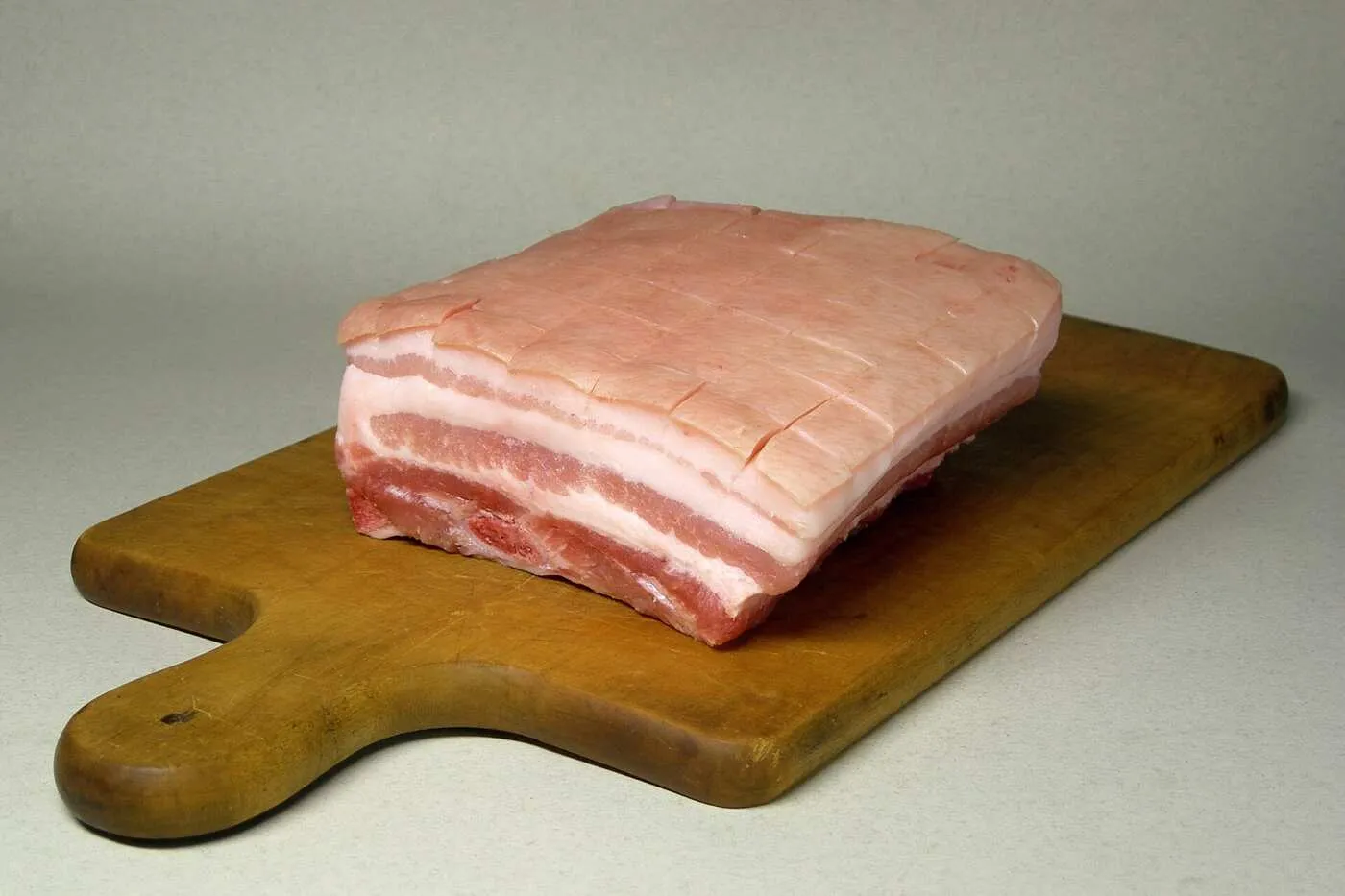 Photo: Rainer Zenz, CC BY-SA 3.0, via Wikimedia Commons
Lean cuts — loin and tenderloin: The loin and tenderloin are the leanest and most protein-dense cuts, with about 3.5 g fat per 100 g for roasted lean tenderloin and roughly 6–10 g for lean loin roasts (USDA FoodData Central; USDA FoodData Central). These are best suited to quick cooking methods (roasting to 63°C/145°F, pan-searing, or grilling) that preserve moisture; they dry out easily if overcooked. Roasted lean pork tenderloin (about 143 kcal per 100 g) is comparable in calories and fat to roasted skinless chicken breast (about 165 kcal; USDA FoodData Central).
Safe internal temperature — USDA guidelines: The USDA Food Safety and Inspection Service (FSIS) recommends cooking fresh whole-muscle pork cuts (chops, roasts, loin, tenderloin) to an internal temperature of 145°F (62.8°C), measured with a food thermometer before removing the meat from the heat, followed by a rest of at least 3 minutes. Ground pork and organ meats such as liver must reach 160°F (71°C) (USDA FSIS, Safe Minimum Internal Temperature Chart). According to FSIS, fresh pork that has reached 145°F throughout may still be pink in the center and should be safe (USDA FSIS, Fresh Pork From Farm to Table).
Fatty cuts — shoulder, belly, ribs: Higher fat content (about 21 g/100 g for roasted shoulder and 30 g for braised spareribs; USDA FoodData Central; USDA FoodData Central) makes these cuts more suitable for slow, moist-heat cooking methods that allow collagen-to-gelatin conversion: braising, slow roasting, smoking. Pork belly (fresh uncured) is high in saturated and monounsaturated fat and is calorie-dense; it is best treated as an occasional ingredient rather than a daily staple for individuals managing caloric or fat intake.
Cured and processed pork products: Bacon, ham, salami, prosciutto, chorizo, and sausage are salt-cured, smoked, or fermented preparations that preserve pork for extended storage. These products are high in sodium and often contain nitrites/nitrates as preservatives. Processed meat consumption has been associated with modestly elevated risks of colorectal cancer in observational studies (IARC Group 1 classification), with an estimated 18% increase in risk per 50 g/day increment of processed meat (Bouvard et al., 2015); the evidence applies to cured and processed products, not to fresh pork.
Organ meats: Pork liver, like beef liver, is exceptionally nutrient-dense, providing very high concentrations of vitamin A, B vitamins (including thiamine, B12, folate), iron, copper, and zinc. As with all liver, it should be consumed in moderation rather than in large daily quantities due to the potential for vitamin A toxicity from preformed retinol.
For context on red meat within a whole dietary pattern, the brain-health guide outlines the MIND diet, which favors poultry and fish and limits red meat.
Safety, Interactions, and Contraindications
Trichinellosis (Trichinella spiralis and related species): Trichinellosis is a parasitic infection caused by larvae of Trichinella roundworms, traditionally associated with consumption of undercooked pork. Pigs acquire Trichinella by consuming infected rodents or infected meat; in outdoor/pastured pigs with access to wildlife habitat, exposure opportunity may be higher than in confinement-raised pigs. In North American commercial pork production, trichinellosis has been effectively controlled through regulatory surveillance, feed rules (federal law bars feeding uncooked food waste to pigs, requiring it to be boiled first, and many states ban garbage feeding outright; USDA APHIS), and production system management; the risk from commercial U.S. pork is now very low: during 2008–2012 a median of 15 trichinellosis cases per year were reported nationwide from all sources, and only 10 cases over the five years were linked to commercial pork, with more coming from bear meat and wild boar (Wilson et al., 2015). However, the risk is not zero, particularly from pastured pigs with wildlife contact or from backyard/small-farm operations outside commercial regulatory oversight. Wild boar carries a substantially higher Trichinella risk and should always be cooked thoroughly; the CDC notes that freezing may not kill all Trichinella in wild game, and that curing, drying, smoking, or microwaving alone does not reliably kill the worms (CDC). For fresh pork, FSIS considers 145°F (62.8°C) with a 3-minute rest safe, and states that pork must be adequately cooked to eliminate parasites such as Trichinella spiralis (USDA FSIS, Fresh Pork From Farm to Table).
Yersinia enterocolitica: Yersinia is a gram-negative bacterium particularly associated with pork, including chitterlings (pork intestines) and poorly cooked pork products. The CDC notes that infection is often linked to raw or undercooked pork, that children are more likely to be infected than adults, and that people who prepare chitterlings can pass the bacteria to infants through their hands (CDC). Adequate cooking temperatures eliminate this pathogen.
Sodium in processed pork products: Cured and processed pork products (bacon, ham, sausage) typically contain roughly 800–1,700 mg of sodium per 100 g (USDA FoodData Central; USDA FoodData Central) and should be accounted for in total dietary sodium tracking, particularly for individuals managing hypertension, heart failure, or chronic kidney disease.
Dietary fat and cardiovascular considerations: High consumption of saturated fat from fatty pork cuts (belly, shoulder, ribs) is consistent with dietary patterns associated with elevated LDL-C in some individuals, though the relationship between specific saturated fatty acids and cardiovascular outcomes is more nuanced than historically represented. Trial evidence on lean fresh pork is limited: in one small crossover trial in 33 adults at cardiovascular risk, a Mediterranean diet with 2–3 weekly serves of fresh lean pork produced no significant differences in blood pressure or fasting lipids compared with a low-fat control diet (Wade et al., 2019).
Gout and hyperuricemia: Pork is moderately high in purines, with organ meats particularly high. Individuals with gout or hyperuricemia should moderate pork consumption, particularly organ meats, in the context of overall purine intake management.
IARC classification of processed meat: The International Agency for Research on Cancer (IARC) has classified processed meats (including bacon, ham, hot dogs, and sausage) as Group 1 carcinogens (sufficient evidence of cancer causation in humans) based on colorectal cancer evidence. Fresh, unprocessed red meat, including pork, is classified as Group 2A (probably carcinogenic), based on limited evidence in humans (Bouvard et al., 2015); the risk, if any, is lower and less certain than for processed forms. This classification is based on the statistical association observed in epidemiological studies, and absolute risk increases attributable to modest red meat consumption are relatively small, but individuals with family history of colorectal cancer or other risk factors may wish to limit processed meat intake in particular.
Frequently Asked Questions
Is pork good for you?
Fresh, lean pork is a nutrient-dense protein: 100 g of roasted loin provides 26–29 g of complete protein, most of a day’s thiamine, and useful selenium, zinc, niacin and B6. Processed pork is the concern, since IARC classes processed meat as carcinogenic and links each 50 g a day with an estimated 18% higher colorectal cancer risk.
Is pork red meat?
Yes. Pork is classed as red meat in nutrition research and by the International Agency for Research on Cancer, which groups fresh pork with beef and lamb as unprocessed red meat (Group 2A, probably carcinogenic). Lean pork cuts can be similar to chicken breast in fat and calories, but pork is still counted as red meat.
Does pork have iron?
Pork contains heme iron, the form absorbed more efficiently than the non-heme iron in plant foods, but not a large amount: about 1.1–1.3 mg per 100 g cooked. That is roughly half the iron in the same weight of ground beef. Pork liver is a much richer iron source, though it also carries a lot of preformed vitamin A.
Is pork a good source of protein?
Yes. Roasted lean pork loin and tenderloin provide about 26–29 g of protein per 100 g, with all nine essential amino acids and about 2.2–2.3 g of leucine. In two small crossover trials, lean pork produced greater blood essential amino acid availability than ounce-equivalent portions of eggs, black beans or almonds; muscle growth was not measured.
Is pastured pork healthier than conventional pork?
Pastured pork can differ in composition: outdoor-reared pigs had more polyunsaturated fat and vitamin E in one Swedish study, and sun-exposed pigs had about three times more vitamin D in a small U.S. study. No human trial has tested whether those differences improve health. Pigs with wildlife contact may also face more Trichinella exposure, so thorough cooking matters.
References
Show all 14 referencesShow fewer
- Larson-Meyer, D. E., Ingold, B. C., Fensterseifer, S. R., et al. (2017). Sun exposure in pigs increases the vitamin D nutritional quality of pork. PLoS One, 12(11), e0187877.
- Nilzén, V., Babol, J., Dutta, P. C., et al. (2001). Free range rearing of pigs with access to pasture grazing — effect on fatty acid composition and lipid oxidation products. Meat Science, 58(3), 267–275.
- Connolly, G., Hudson, J. L., Bergia, R. E., et al. (2023). Effects of consuming ounce-equivalent portions of animal- vs. plant-based protein foods, as defined by the Dietary Guidelines for Americans, on essential amino acids bioavailability in young and older adults: Two cross-over randomized controlled trials. Nutrients, 15(13), 2870.
- U.S. Department of Agriculture Food Safety and Inspection Service. Safe minimum internal temperature chart.
- Agarwal, S., & Fulgoni, V. L., 3rd. (2023). Association of pork (all pork, fresh pork and processed pork) consumption with nutrient intakes and adequacy in US children (age 2–18 years) and adults (age 19+ years): NHANES 2011–2018 analysis. Nutrients, 15(10), 2293.
- Högberg, A., Pickova, J., Stern, S., Lundström, K., & Bylund, A. C. (2004). Fatty acid composition and tocopherol concentrations in muscle of entire male, castrated male and female pigs, reared in an indoor or outdoor housing system. Meat Science, 68(4), 659–665.
- Bouvard, V., Loomis, D., Guyton, K. Z., et al. (2015). Carcinogenicity of consumption of red and processed meat. Lancet Oncology, 16(16), 1599–1600.
- Wilson, N. O., Hall, R. L., Montgomery, S. P., & Jones, J. L. (2015). Trichinellosis surveillance — United States, 2008–2012. MMWR Surveillance Summaries, 64(1), 1–8.
- U.S. Department of Agriculture Food Safety and Inspection Service. Fresh pork from farm to table.
- Centers for Disease Control and Prevention. Preventing trichinellosis.
- Wade, A. T., Davis, C. R., Dyer, K. A., Hodgson, J. M., Woodman, R. J., & Murphy, K. J. (2019). Effects of Mediterranean diet supplemented with lean pork on blood pressure and markers of cardiovascular risk: findings from the MedPork trial. British Journal of Nutrition, 122(8), 873–883.
- A Greener World. Certified Animal Welfare Approved by AGW: pig standards.
- USDA Animal and Plant Health Inspection Service. What swine growers need to know about garbage feeding.
- Centers for Disease Control and Prevention. About Yersinia infection.
More in Animal Foods
- Anchovies (Engraulis encrasicolus)
Anchovies vs sardines: how the two small oily fish compare on omega-3s, calcium, B12, sodium and mercury, plus anchovy nutrition, benefits and safety.
- Beef Liver
Is beef liver good for you? Its B12, vitamin A, copper and iron per 100 g, how often to eat it, liver supplements, and the vitamin A toxicity limit.
- Bone Broth
Is bone broth good for you? What a cup contains, how it compares with collagen supplements and chicken broth, and the evidence on joints, gut and sleep.
- Eggs
Are eggs good for you? Egg nutrition per large egg, whole eggs vs egg whites, what cohort studies show on cholesterol and heart risk, and egg safety.
- Grass-Fed Beef
Grass-fed vs grain-fed beef: how omega-3s, CLA, vitamin E, fat, protein, iron and zinc compare, what the USDA grass-fed label means, and red meat cautions.
- Oysters
Oyster benefits: zinc, B12, copper, selenium and omega-3s per serving, what the evidence shows, how many to eat, and the Vibrio risk of raw oysters.

Curated by Superfoods Advisor Editors·Last updated