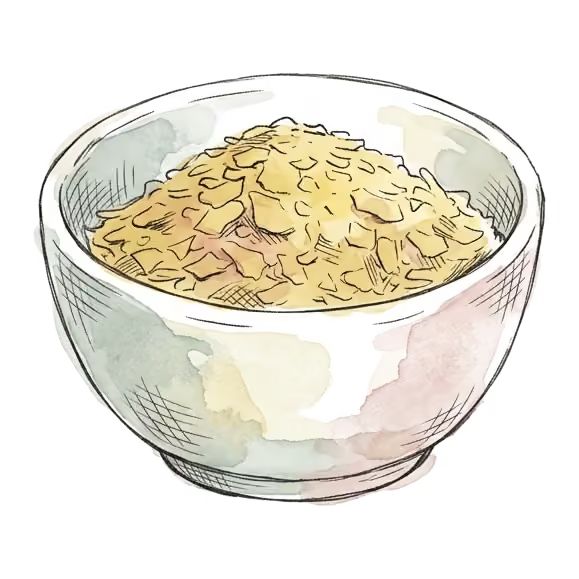
Nutritional Yeast
Saccharomyces cerevisiae · also known as nooch, yeast flakes, savory yeast, inactive yeast, deactivated yeast
By Superfoods Advisor Editors·July 3, 2026
Is nutritional yeast good for you? About 8 g complete protein per 15 g, B vitamins and B12 if fortified, vs brewer's yeast, daily amounts and gout.
Nutritional yeast is deactivated Saccharomyces cerevisiae sold as savory yellow flakes. For most people it is a nutritious seasoning: about 8 g of complete protein per 15 g serving plus B vitamins, and fortified versions supply vitamin B12. People with gout should be cautious, because yeast is among the highest-purine foods.
It is the same species used in bread leavening and beer fermentation, grown specifically for food use and then deactivated by heat. The deactivation step distinguishes nutritional yeast from active dry yeast (still alive and sold for leavening) and from brewer’s yeast (a fermentation byproduct with a more bitter flavor profile). The result is a golden-yellow flaked or powdered ingredient with a characteristically savory, umami-forward, often described as “cheesy” or “nutty” flavor, widely used in plant-based cooking as a dairy flavor substitute.
Nutritional yeast’s appeal rests on its combination of complete protein — containing all nine essential amino acids — with a dense B-vitamin profile, beta-glucan cell wall polysaccharides, trace minerals, and modest calories per serving. However, several important distinctions must be understood: the presence of vitamin B12 depends entirely on whether the product has been fortified (unfortified nutritional yeast contains no B12 of biological significance); the glutamic acid content, while naturally occurring, deserves consideration for those with sensitivities; and the purine content merits attention in individuals with gout or hyperuricemia.
Evidence at a glance
Active Compounds and Composition
Serving weights vary with flake size: 2 tablespoons of large flakes weigh only about 5–10 g, so labels often use a ~15 g serving (about 1/4 cup of large flakes). Per ~15 g, the composition typically includes:
- Protein: Approximately 8 g per 15 g serving (USDA FoodData Central, Bob’s Red Mill; Foods Alive, unfortified); complete amino acid profile including all nine essential amino acids. Notably high in glutamic acid (a naturally occurring amino acid, structurally identical to the monosodium glutamate component of MSG — see safety section) and lysine, in which many plant foods are limiting.
- B-vitamins (fortified products): Thiamine (B1), riboflavin (B2), niacin (B3), pantothenic acid (B5), pyridoxine (B6) — fortified products often list several hundred percent of the Daily Value per serving (one lists 6.2 mg thiamin, about 500% DV, per 10 g; USDA FoodData Central). Vitamin B12 (cyanocobalamin or methylcobalamin): present only in fortified versions; unfortified nutritional yeast contains no B12. This distinction is critical for vegans and vegetarians using nutritional yeast as a B12 source. Verify the Nutrition Facts panel for each product.
- Folate (B9): Naturally present in modest amounts (one unfortified product lists 40 mcg per 15 g; USDA FoodData Central); fortified products with added folic acid list several hundred mcg or more (USDA FoodData Central).
- Minerals: Zinc (about 3 mg per 15 g in one unfortified product; USDA FoodData Central), plus selenium, iron, and phosphorus. Sodium is low in plain, unseasoned products (roughly 5–25 mg per 15 g serving; USDA FoodData Central); seasoned blends can carry far more.
- Fiber: Approximately 3–4 g per 15 g serving (USDA FoodData Central), primarily from the yeast cell wall.
- Beta-glucans: (1→3)(1→6)-β-D-glucans are a major structural component of the S. cerevisiae cell wall; in one compositional study of several yeast species, mannoproteins made up 25–34% of the wall and glucan fractions most of the remainder (Nguyen et al., 1998). These differ structurally from the oat (1→3)(1→4)-β-D-glucans; the branching pattern affects receptor binding and immune signaling properties.
- Nucleic acids: Yeast is relatively rich in nucleic acids (RNA, DNA), which are catabolized to purines and ultimately uric acid in humans. This is a source of concern in gout-prone individuals (see safety section).
- Trehalose: A disaccharide storage carbohydrate in yeast; metabolized normally in humans.
Evidence for Purported Benefits
Immune Function (Beta-Glucan Signaling)
Evidence:Preliminary Receptor effects shown in the lab; trials of isolated yeast beta-glucan at higher doses than food provides are mixed.
Yeast-derived (1→3)(1→6)-β-D-glucans are recognized by pattern recognition receptors on immune cells, particularly Dectin-1 on macrophages and dendritic cells, and Complement Receptor 3 (CR3) (Brown & Gordon, 2001). In laboratory studies, this binding stimulates innate immune activation: enhanced phagocytosis, reactive oxygen species production, and cytokine release including TNF-α and interleukins. Multiple clinical trials have investigated baker’s and brewers’ yeast beta-glucan (often sold as a separate supplement under brand names such as WGP 3-6 or Wellmune) for reducing upper respiratory tract infection incidence and severity. Auinger et al. (2013, European Journal of Nutrition) (n = 162 healthy adults with recurring infections) reported 25% fewer common cold episodes with 900 mg/day of an insoluble brewers’ yeast beta-glucan over 16 weeks compared with placebo, though the 15% lower symptom score was not statistically significant. Dharsono et al. (2019, Journal of the American College of Nutrition) (n = 299) found no difference in the number of infections but reported lower physical symptom severity during episodes with the same dose. However, the doses of isolated beta-glucan in these trials (900 mg–1 g/day of purified material) exceed what typical nutritional yeast servings provide as whole food; direct extrapolation requires caution.
Protein Nutrition and Amino Acid Supply
Evidence:Strong Complete-protein composition is measured directly; the digestibility scores come from a rat and lab study of a yeast protein preparation.
Nutritional yeast is a complete protein source. In a rat and in-vitro digestion study of a yeast protein preparation, Cao et al. (2025, Food Chemistry) reported a PDCAAS of 100% and a DIAAS of about 82% for people over 3 years — above the plant proteins tested (soy, wheat, pea) but below whey, mainly because yeast protein was less digestible (Cao et al., 2025). Values for whole nutritional yeast flakes have not been established the same way. For plant-based eaters, it provides particularly valuable lysine (often limiting in grain-based diets). The roughly 8 g of protein per 15 g serving is meaningful in the context of an overall plant-based dietary pattern, though it should be understood as a complement to — rather than a primary replacement for — a diverse protein portfolio.
Vitamin B12 Status (Fortified Products Only)
Evidence:Moderate B12’s role is well established and fortified yeast supplies meaningful amounts; the yeast itself has not been trialled for B12 status.
Vitamin B12 occurs naturally almost only in animal-derived foods; some fermented foods, algae, and mushrooms may contain small amounts of the active form (Linus Pauling Institute). Nutritional yeast is one of the few fortified plant-based foods providing meaningful B12 in amounts relevant to meeting daily requirements (2.4 mcg/day for adults; NIH Office of Dietary Supplements). Fortified products vary widely, from about 2 mcg per tablespoon (USDA FoodData Central) to 15 mcg per 2-tablespoon serving, over 600% of the Daily Value (USDA FoodData Central), usually as cyanocobalamin. However, it is essential to emphasize that unfortified nutritional yeast does not contain B12 — despite occasional claims to the contrary. Some manufacturers add methylcobalamin rather than cyanocobalamin; either form is bioavailable. Vegans relying on nutritional yeast as their sole B12 source should confirm their specific product is fortified and keep in mind that no single blood test is definitive: serum B12 is an imperfect marker, and methylmalonic acid (MMA) is the more specific indicator of deficiency (Linus Pauling Institute).
Cholesterol Modulation
Evidence:Preliminary One small uncontrolled study; the FDA heart-health claim covers oat and barley beta-glucan, not yeast.
Beta-glucans from yeast have been investigated for cholesterol-lowering effects, distinct from well-documented oat beta-glucan. Yeast beta-glucan’s (1→3)(1→6) branching structure may reduce its viscosity and therefore its LDL-reducing efficacy compared to oat (1→3)(1→4)-β-D-glucan. A small uncontrolled study by Nicolosi et al. (1999, American Journal of Clinical Nutrition) (n = 15 obese men with high cholesterol) found that 15 g/day of yeast beta-glucan fiber for eight weeks lowered total cholesterol by 6–8%, but the evidence base is far weaker than for oat beta-glucan. The FDA’s authorized health claim for beta-glucan and heart disease risk reduction applies specifically to oat and barley beta-glucan at 3 g/day (21 CFR 101.81) — this claim does not extend to yeast beta-glucan.
Typical Use and Dosing
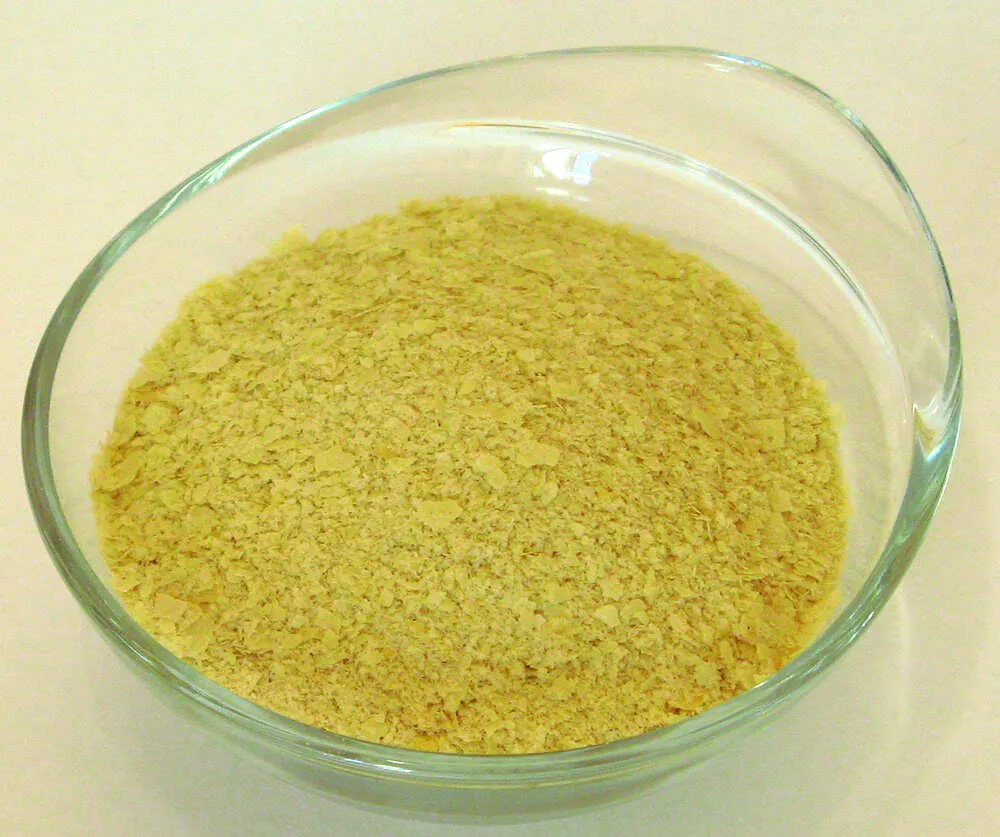 Photo: myself/my spouse, CC BY-SA 3.0, via Wikimedia Commons
Nutritional yeast is used primarily as a culinary ingredient rather than a pharmaceutical supplement, which distinguishes its usage pattern from most entries in this category:
- Culinary dosing: 1–4 tablespoons per day is a typical consumer range; used sprinkled on pasta, salads, popcorn, and blended into sauces, dips (e.g., vegan cheese sauces), and soups.
- Protein contribution: About 15 g (≈1/4 cup of large flakes) provides roughly 8 g protein.
- B12 (fortified): 1–2 tablespoons of a fortified product typically meets or exceeds the adult B12 RDA.
- Beta-glucan (immune context): Research-level doses of isolated yeast beta-glucan (900 mg–1 g/day) exceed what is reasonably delivered through nutritional yeast as food; whole food consumption is not equivalent to isolated supplements in this application.
No upper limit has been set for nutritional yeast as a food, and none exists for vitamin B12. Fortified products, however, also add niacin and folic acid, which do have adult upper limits (35 mg/day niacin; 1,000 mcg/day folic acid from fortified foods and supplements; Linus Pauling Institute on niacin and folate). Heavy daily use of a highly fortified product alongside a multivitamin can approach the niacin limit, so check the label.
Nutritional yeast is covered as a protein source in the plant-based protein guide.
Safety, Interactions, and Contraindications
Purines and uric acid (gout consideration): Yeast is among the highest-purine foods, alongside organ meats and some fish (Kaneko et al., 2014). Dietary purines are catabolized to uric acid; elevated serum uric acid (hyperuricemia) precipitates gout flares and may contribute to urate kidney stone formation. Individuals with gout, a history of gout, or chronically elevated serum uric acid should limit or avoid nutritional yeast and consult with their physician regarding dietary purine management.
Glutamic acid and MSG sensitivity: Nutritional yeast contains substantial quantities of naturally occurring glutamic acid — the free amino acid form of the same compound that constitutes the “MSG” in monosodium glutamate. The “MSG sensitivity” or “Chinese Restaurant Syndrome” narrative has been largely questioned in the scientific literature; placebo-controlled trials have not consistently reproduced symptoms or confirmed an MSG-sensitive subgroup (Freeman, 2006). However, individuals who self-report sensitivity to MSG may also react to nutritional yeast’s glutamate content. The appropriate qualifier is that the evidence for MSG sensitivity is weak, not that individual responses are fabricated.
Tyramine content: Some fermented and yeast-derived foods contain tyramine, a monoamine formed from tyrosine during microbial processing. People taking MAOI antidepressants (phenelzine, tranylcypromine, isocarboxazid) restrict high-tyramine foods to avoid a hypertensive crisis. A widely used MAOI diet restricts concentrated yeast extract such as Marmite but does not list whole yeast flakes (Gardner et al., 1996); published tyramine data for nutritional yeast itself are scarce, so people on MAOIs should check with their pharmacist or physician.
Inflammatory bowel disease: Many people with Crohn’s disease carry antibodies to S. cerevisiae cell wall mannan (ASCA). In a small crossover study of 19 patients with stable Crohn’s disease, disease activity was slightly higher while taking baker’s yeast capsules than during yeast exclusion, most consistently in those with raised yeast antibodies (Barclay et al., 1992). Evidence is limited, but people with Crohn’s disease may wish to discuss yeast intake with their gastroenterologist.
Candida sensitivity myth: A widespread claim suggests nutritional yeast worsens Candida albicans infections. This conflates different yeast species — Saccharomyces cerevisiae and Candida albicans are taxonomically distinct; and nutritional yeast is inactivated. The concern has not been supported by published clinical evidence.
Product Selection Criteria
- B12 fortification verification: Confirm the Nutrition Facts panel lists cyanocobalamin or methylcobalamin explicitly. Do not assume fortification — it must be declared.
- Flakes vs. powder: Flakes are more commonly used in cooking; powder mixes more smoothly into sauces and smoothies. Nutritional differences are minimal; personal preference governs.
- Non-MSG-added: Quality nutritional yeast should not have added monosodium glutamate or other sodium compounds; the natural glutamic acid content provides the characteristic umami flavor without additives.
- Third-party testing: Heavy metal testing (cadmium, lead, arsenic) and microbial testing are relevant for a product consumed regularly in gram quantities.
- Packaging: Resealable, light-protective packaging (foil bags, opaque containers) preserves B-vitamin stability.
Frequently Asked Questions
Does nutritional yeast have B12?
Only if it is fortified. Unfortified nutritional yeast contains no B12 of biological significance, despite occasional claims otherwise. Fortified products range from about 2 mcg per tablespoon to 15 mcg per 2 tablespoons, against an adult requirement of 2.4 mcg a day. Vegans relying on it should check that the Nutrition Facts panel lists cyanocobalamin or methylcobalamin.
How much nutritional yeast per day is too much?
No upper limit has been set for nutritional yeast as a food, and 1 to 4 tablespoons a day is a typical range. The constraint is fortification: some products add niacin and folic acid, which have adult upper limits of 35 mg and 1,000 mcg a day. Daily use of a highly fortified brand alongside a multivitamin can approach the niacin limit.
Is nutritional yeast the same as brewer’s yeast or active dry yeast?
All three are Saccharomyces cerevisiae, but they are different products. Active dry yeast is alive and used to raise bread. Brewer’s yeast is a byproduct of beer fermentation with a more bitter taste. Nutritional yeast is grown for food and then heat-deactivated, giving it a savory, cheese-like flavor; it cannot leaven dough.
Is nutritional yeast bad for gout?
It can be. Yeast is among the highest-purine foods, alongside organ meats and some fish, and purines are broken down into uric acid, which drives gout flares. People with gout, a history of gout or high uric acid are usually advised to limit or avoid it and to discuss purine intake with their physician.
Does nutritional yeast contain MSG?
Not added MSG, in plain products. It does contain naturally occurring glutamic acid, the same compound found in monosodium glutamate, which gives it its umami taste. Placebo-controlled trials have not consistently confirmed an MSG-sensitive group, but people who notice symptoms from MSG may react to nutritional yeast too.
References
Show all 10 referencesShow fewer
- Auinger, A., Riede, L., Bothe, G., Busch, R., & Gruenwald, J. (2013). Yeast (1,3)-(1,6)-beta-glucan helps to maintain the body’s defence against pathogens: A double-blind, randomized, placebo-controlled, multicentric study in healthy subjects. European Journal of Nutrition, 52(8), 1913–1918.
- Dharsono, T., Rudnicka, K., Wilhelm, M., & Schoen, C. (2019). Effects of yeast (1,3)-(1,6)-beta-glucan on severity of upper respiratory tract infections: A double-blind, randomized, placebo-controlled study in healthy subjects. Journal of the American College of Nutrition, 38(1), 40–50.
- Nicolosi, R., Bell, S. J., Bistrian, B. R., Greenberg, I., Forse, R. A., & Blackburn, G. L. (1999). Plasma lipid changes after supplementation with beta-glucan fiber from yeast. American Journal of Clinical Nutrition, 70(2), 208–212.
- Freeman, M. (2006). Reconsidering the effects of monosodium glutamate: A literature review. Journal of the American Academy of Nurse Practitioners, 18(10), 482–486.
- Nguyen, T. H., Fleet, G. H., & Rogers, P. L. (1998). Composition of the cell walls of several yeast species. Applied Microbiology and Biotechnology, 50(2), 206–212.
- Cao, X., Liu, H., Yang, M., et al. (2025). Evaluation of the nutritional quality of yeast protein in comparison to animal and plant proteins using growing rats and INFOGEST model. Food Chemistry, 463(Pt 2), 141178.
- Brown, G. D., & Gordon, S. (2001). Immune recognition. A new receptor for beta-glucans. Nature, 413(6851), 36–37.
- Kaneko, K., Aoyagi, Y., Fukuuchi, T., Inazawa, K., & Yamaoka, N. (2014). Total purine and purine base content of common foodstuffs for facilitating nutritional therapy for gout and hyperuricemia. Biological & Pharmaceutical Bulletin, 37(5), 709–721.
- Gardner, D. M., Shulman, K. I., Walker, S. E., & Tailor, S. A. (1996). The making of a user friendly MAOI diet. Journal of Clinical Psychiatry, 57(3), 99–104.
- Barclay, G. R., McKenzie, H., Pennington, J., Parratt, D., & Pennington, C. R. (1992). The effect of dietary yeast on the activity of stable chronic Crohn’s disease. Scandinavian Journal of Gastroenterology, 27(3), 196–200.
Related content
More in Supplements & Ingredients
- Berberine
Berberine for weight loss: trials show about 1 to 2 kg, not Ozempic-level results, plus blood sugar and LDL effects, dosage, side effects and interactions.
- CBD (Cannabidiol)
CBD for sleep: what the research shows, how CBD differs from THC, plus the anxiety and epilepsy evidence, dosing, legal status and side effects.
- Collagen (Hydrolyzed Collagen Peptides)
Collagen peptides benefits weighed against the trials: skin elasticity, joint pain, bone density and muscle, plus daily dose, timing and side effects.
- Inulin
What is inulin? A prebiotic fiber from chicory root and other plants: how it feeds gut bacteria, benefits, daily dose, side effects and inulin vs psyllium.
- MCT Oil (Medium-Chain Triglycerides)
What is MCT oil? C8 and C10 fats fractionated from coconut or palm kernel oil. Ketones, weight and brain evidence, vs coconut oil, dose and side effects.
- Resveratrol (trans-3,5,4'-Trihydroxystilbene)
Resveratrol benefits weighed against the evidence: under 1% bioavailability, mixed human trials, no lifespan gain in rigorous mouse tests, plus safety.

Browse all supplements & ingredients →
Curated by Superfoods Advisor Editors·Last updated