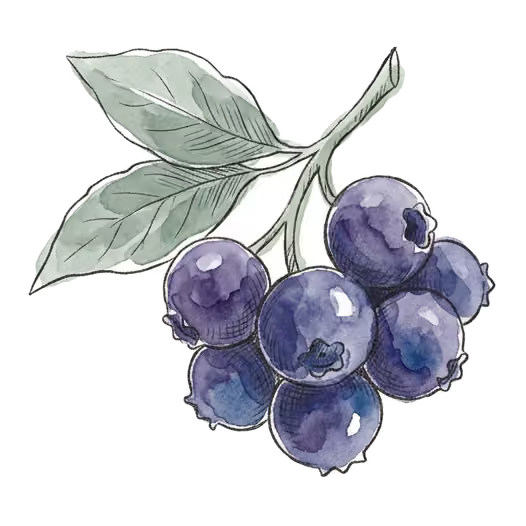
Blueberry (Vaccinium corymbosum)
Vaccinium corymbosum · also known as highbush blueberry, northern blueberry, cultivated blueberry
By Superfoods Advisor Editors·July 3, 2026
Are blueberries good for you? Trials suggest a daily cup (150 g) may help blood-vessel function; memory and blood-sugar data are early. Nutrition, safety.
Blueberries (Vaccinium corymbosum, the cultivated highbush blueberry) are good for you as a low-calorie fruit rich in anthocyanins, with 57 kcal and 2.4 g of fiber per 100 g. Among berries they have one of the larger trial bases: about one cup (150 g) a day improved blood-vessel function in randomized trials, while memory and blood-sugar results are less consistent.
The plant is a deciduous shrub in the heath family (Ericaceae), native to eastern North America. Wild lowbush blueberries (V. angustifolium) and European bilberries (V. myrtillus) share a closely related phytochemical profile, and Indigenous North American peoples have long eaten wild blueberries fresh and dried.
The berry’s anthocyanins, from the malvidin, delphinidin, cyanidin, petunidin and peonidin subclasses, underpin research on cardiovascular risk, cognitive aging and insulin sensitivity. Some commercial claims still run ahead of that research.
Evidence at a glance
Active Compounds
Blueberries contain a diverse and well-characterized polyphenol profile:
- Anthocyanins — the primary bioactives; one mass-spectrometry analysis identified 25 distinct anthocyanins in highbush fruit (Barnes et al., 2009), primarily glucosides, galactosides, and arabinosides of delphinidin, cyanidin, petunidin, peonidin, and malvidin. Total anthocyanin content varies widely with cultivar, ripeness, and growing conditions, and lowbush (wild) blueberries are consistently higher than cultivated highbush (Kalt et al., 2001).
- Chlorogenic acid and other hydroxycinnamic acids — contributing antioxidant capacity and in laboratory studies, chlorogenic acid has been studied for slowing intestinal glucose uptake.
- Quercetin and myricetin glycosides — flavonols with anti-inflammatory and antioxidant properties.
- Pterostilbene — a methylated stilbene (structurally related to resveratrol) found in trace amounts; studied in preclinical models for anti-inflammatory and neuroprotective properties, and more bioavailable than resveratrol in a rat study (Kapetanovic et al., 2011).
- Vitamin C — approximately 9.7 mg per 100 g; modest contributor to antioxidant profile.
- Vitamin K1 — approximately 19 µg per 100 g.
- Dietary fiber — approximately 2.4 g per 100 g.
- Manganese — a notable mineral constituent; approximately 0.34 mg per 100 g.
Nutritional Profile
Values below are for raw cultivated blueberries per 100 g (USDA FoodData Central, “Blueberries, raw”):
| Nutrient | Amount per 100 g | % DV |
|---|---|---|
| Energy | 57 kcal | — |
| Total fat | 0.3 g | — |
| Total carbohydrates | 14.5 g | — |
| Dietary fiber | 2.4 g | — |
| Total sugars | 10.0 g | — |
| Protein | 0.7 g | — |
| Vitamin C | 9.7 mg | — |
| Vitamin K | 19 µg | — |
| Vitamin E | 0.6 mg | — |
| Folate | 6 µg | — |
| Manganese | 0.34 mg | — |
| Potassium | 77 mg | — |
Evidence for Purported Benefits
Blueberry has accumulated one of the larger human clinical trial bases of any berry. Many trials are short-term, small, and conducted in specific populations; interpretation requires attention to dose, form, and comparator.
Cardiovascular Risk Markers
Evidence:Moderate A meta-analysis of 11 trials and a six-month RCT show better endothelial function; lipids and systolic pressure unchanged.
Several RCTs have reported improvements in some cardiovascular risk markers with blueberry consumption. A systematic review and meta-analysis by Deng and colleagues (2024, Frontiers in Physiology, 11 studies meta-analysed) found that blueberry consumption improved endothelial function (flow-mediated dilation: +1.50%) and modestly lowered diastolic blood pressure (−2.20 mmHg) compared to control, while systolic blood pressure and LDL and HDL cholesterol did not change significantly. A key 2019 RCT by Curtis and colleagues (The American Journal of Clinical Nutrition, n=115) found that 1 cup (150 g) of blueberries daily for six months improved flow-mediated dilation and arterial stiffness in adults with metabolic syndrome, although blood pressure and insulin resistance were unaffected and a half cup per day had no effect.
Crossover trials by Rodriguez-Mateos and colleagues (2013, The American Journal of Clinical Nutrition, n=21) found that a single blueberry drink acutely improved endothelial function in healthy men, with flow-mediated dilation rising at 1–2 and 6 hours and plateauing above about 766 mg of blueberry polyphenols. Long-term cardiovascular endpoint trials (MI, stroke) have not been conducted.
Cognitive Function and Brain Health
Evidence:Limited Several small RCTs in older adults; gains appear on single memory measures and are not consistent across forms.
A growing body of short-term trials suggests that blueberry supplementation may improve aspects of episodic memory and processing speed in older adults with mild cognitive concerns. Whyte and colleagues (2018, Nutrients, n=122) found that a 100 mg/day wild blueberry extract improved delayed word recognition at three months in adults aged 65–80 compared to placebo, though other cognitive measures showed at most trends and whole blueberry powder (500–1,000 mg/day) showed no clear benefit. Krikorian and colleagues (2010, Journal of Agricultural and Food Chemistry, n=9) reported improved paired associate learning and word list recall in older adults with early memory changes after twelve weeks of daily wild blueberry juice, but the study had no concurrent placebo group. Sample sizes in this literature are small, and larger multicenter RCTs are needed before firm recommendations can be made.
Proposed mechanisms include increased cerebral blood flow, seen in one small 12-week MRI trial in healthy older adults (Bowtell et al., 2017), and BDNF-related neuroplasticity, which so far comes from rat studies (Williams et al., 2008).
Insulin Sensitivity and Metabolic Effects
Evidence:Limited Two small RCTs, one six-week and one single-meal, both favorable; effect sizes are modest.
A double-blind RCT by Stull and colleagues (2010, Journal of Nutrition, n=32) found that six weeks of smoothies containing 22.5 g of blueberry bioactives, taken twice daily, improved insulin sensitivity (measured by hyperinsulinemic-euglycemic clamp) in obese, non-diabetic, insulin-resistant adults more than a matched placebo smoothie, without changes in inflammatory markers. A 2022 double-blind RCT by Curtis and colleagues (Clinical Nutrition, n=45) in adults with metabolic syndrome found that adding the equivalent of 1 cup of blueberries (as freeze-dried powder) to a single high-fat, high-sugar drink lowered post-meal glucose and insulin over the following hours, though vascular function and blood pressure did not change. Mechanisms such as slowed glucose uptake by berry polyphenols have been proposed, and effect sizes appear modest and population-dependent.
Anti-inflammatory Effects
Evidence:Limited Short-term trials on CRP, IL-6 and TNF-α; results conflict across populations and doses.
Several short-term trials have reported reductions in inflammatory markers (CRP, IL-6, TNF-α) with blueberry supplementation in specific populations, but findings are inconsistent across trials. The heterogeneity of study populations, doses, and forms makes it difficult to draw firm conclusions. Anti-inflammatory effects from in vitro NF-κB inhibition studies are well-characterized but do not necessarily translate to clinically relevant effects at dietary doses.
Typical Use and Preparation
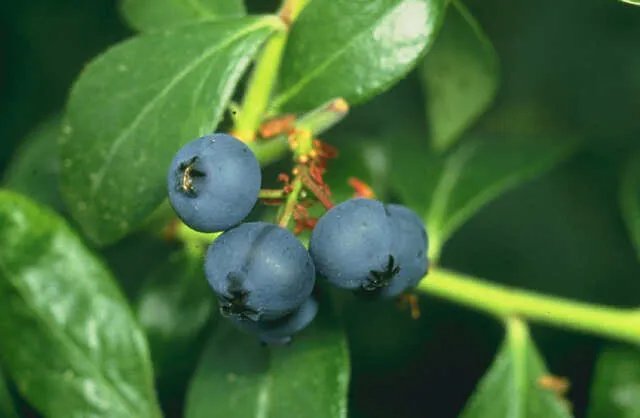 Photo: The original Uploader was Oven Fresh at English Wikipedia, public domain, via Wikimedia Commons
Fresh blueberries are widely available seasonally. In one study, frozen highbush blueberries showed no significant anthocyanin loss over three months of storage, while cabinet drying cut anthocyanins by about 40–50% (Lohachoompol et al., 2004). Heat processing also reduces anthocyanins: in blueberry-filled pastries, stir-frying and baking the filling cut total anthocyanins by roughly half (Yang et al., 2019).
Common forms include:
- Fresh or frozen berries — the six-month Curtis trial compared 75 g and 150 g per day, and only the 150 g (1 cup) dose had measurable effects.
- Freeze-dried powder — used in many clinical trials for standardized dosing; in the Curtis trials, 26 g of powder corresponded to about 150 g of fresh berries (Curtis et al., 2022).
- Juice — anthocyanin content varies by processing; blueberry juice with added sugars should not be substituted for whole berry.
- Extracts in capsules — standardized to total anthocyanin content; doses vary by product, and the Whyte trial used 100 mg per day of a wild blueberry extract.
The trials with positive findings have mostly used the equivalent of about 1 cup (150 g) of fresh berries per day, given as whole fruit or freeze-dried powder.
For breakfast uses, see the overnight oats recipes and the chia pudding recipes. Blueberries also feature in the guides to superfoods for brain health and superfoods for heart health.
Safety, Interactions, and Contraindications
Blueberries are a common food with no recognized toxicity at normal dietary intakes. Safety data for concentrated extracts are more limited.
- Vitamin K content: blueberries contain moderate vitamin K; people on warfarin should keep their intake consistent and talk to their doctor before making large dietary changes.
- Gastrointestinal tolerance: well tolerated at dietary quantities; large supplemental doses of freeze-dried powder may cause loose stools in sensitive individuals due to fiber and polyphenol content.
- Drug interactions: blueberry juice inhibited CYP3A and CYP2C9 enzymes in human liver microsomes, but in healthy volunteers it did not significantly change blood levels of buspirone (CYP3A) or flurbiprofen (CYP2C9) (Hanley et al., 2013). Interactions with concentrated extracts have not been well studied.
- Hypoglycemia risk: given evidence for modest blood glucose-lowering effects, individuals on insulin or oral hypoglycemics who begin high-dose blueberry supplementation should monitor blood glucose.
- Pregnancy and lactation: blueberries are an ordinary food in pregnancy diets, but high-dose extracts lack adequate safety data in pregnancy and lactation.
This article is for informational purposes only. It does not constitute medical advice, and blueberry should not be used to diagnose, treat, prevent, or cure any condition.
Frequently Asked Questions
Are blueberries a superfood?
“Superfood” is a marketing term with no legal definition, but blueberries have one of the larger clinical-trial bases of any berry. The best-supported benefit is blood-vessel function: a meta-analysis of 11 trials found improved flow-mediated dilation, and a six-month trial in 115 adults saw the effect at one cup (150 g) a day but not at half a cup. Memory and insulin-sensitivity results come from small, inconsistent trials. The limit is that no trial has shown blueberries prevent heart attacks or strokes.
What are blueberries good for?
The best-supported effect of blueberries is on blood-vessel function: randomized trials found that about one cup (150 g) a day improved flow-mediated dilation and arterial stiffness. Smaller trials suggest possible benefits for memory in older adults and for insulin sensitivity, but those results are inconsistent. No trial has shown blueberries prevent heart attacks or strokes.
Do blueberries have fiber?
Yes, but less than many other berries. Raw blueberries contain about 2.4 g of fiber per 100 g, so a 150 g cup provides roughly 3.6 g. Raspberries and blackberries have more than twice as much per 100 g. Blueberries are still a useful contributor to daily fiber when eaten regularly.
How many blueberries should you eat a day?
No official target exists for blueberries specifically. The trials with positive results mostly used about 1 cup (150 g) of fresh berries a day, or the equivalent as freeze-dried powder (about 26 g). In the six-month Curtis trial, half a cup a day had no measurable effect. Frozen blueberries work as well as fresh for anthocyanin content.
Are blueberries good for diabetics?
Blueberries can fit a diabetic eating plan, with about 14.5 g of carbohydrate and 2.4 g of fiber per 100 g. Two small trials found improved insulin sensitivity or lower post-meal glucose with blueberry products, but effects were modest. People on insulin or glucose-lowering drugs who start concentrated blueberry supplements should monitor their blood glucose and check with a clinician.
Are wild blueberries better than regular blueberries?
Wild lowbush blueberries consistently contain more anthocyanins than cultivated highbush blueberries, according to compositional studies. Some cognitive trials used wild blueberry extract or juice, but no trial has compared health outcomes between wild and cultivated berries directly. Both are nutritious, and the cultivated kind is the one most trials of whole fruit used.
References
Show all 15 referencesShow fewer
- Deng, B., Lei, Y., Zhou, R., Ruan, T., Lu, W., Ying, J., Yue, Y., & Mu, D. (2024). Effect of blueberry intervention on endothelial function: A systematic review and meta-analysis. Frontiers in Physiology, 15, 1368892.
- Curtis, P. J., van der Velpen, V., Berends, L., Jennings, A., Feelisch, M., Umpleby, A. M., … & Cassidy, A. (2019). Blueberries improve biomarkers of cardiometabolic function in participants with metabolic syndrome — results from a six-month, double-blind, randomized controlled trial. American Journal of Clinical Nutrition, 109(6), 1535–1545.
- Whyte, A. R., Cheng, N., Fromentin, E., & Williams, C. M. (2018). A randomized, double-blinded, placebo-controlled study to compare the safety and efficacy of low dose enhanced wild blueberry powder and wild blueberry extract (ThinkBlue™) in maintenance of episodic and working memory in older adults. Nutrients, 10(6), 660.
- Stull, A. J., Cash, K. C., Johnson, W. D., Champagne, C. M., & Cefalu, W. T. (2010). Bioactives in blueberries improve insulin sensitivity in obese, insulin-resistant men and women. Journal of Nutrition, 140(10), 1764–1768.
- Rodriguez-Mateos, A., Rendeiro, C., Bergillos-Meca, T., Tabatabaee, S., George, T. W., Heiss, C., & Spencer, J. P. (2013). Intake and time dependence of blueberry flavonoid-induced improvements in vascular function: A randomized, controlled, double-blind, crossover intervention study with mechanistic insights into biological activity. American Journal of Clinical Nutrition, 98(5), 1179–1191.
- Krikorian, R., Shidler, M. D., Nash, T. A., Kalt, W., Vinqvist-Tymchuk, M. R., Shukitt-Hale, B., & Joseph, J. A. (2010). Blueberry supplementation improves memory in older adults. Journal of Agricultural and Food Chemistry, 58(7), 3996–4000.
- Curtis, P. J., Berends, L., van der Velpen, V., Jennings, A., Haag, L., Chandra, P., Kay, C. D., Rimm, E. B., & Cassidy, A. (2022). Blueberry anthocyanin intake attenuates the postprandial cardiometabolic effect of an energy-dense food challenge: Results from a double blind, randomized controlled trial in metabolic syndrome participants. Clinical Nutrition, 41(1), 165–176.
- Barnes, J. S., Nguyen, H. P., Shen, S., & Schug, K. A. (2009). General method for extraction of blueberry anthocyanins and identification using high performance liquid chromatography-electrospray ionization-ion trap-time of flight-mass spectrometry. Journal of Chromatography A, 1216(23), 4728–4735.
- Kalt, W., Ryan, D. A., Duy, J. C., Prior, R. L., Ehlenfeldt, M. K., & Vander Kloet, S. P. (2001). Interspecific variation in anthocyanins, phenolics, and antioxidant capacity among genotypes of highbush and lowbush blueberries (Vaccinium section cyanococcus spp.). Journal of Agricultural and Food Chemistry, 49(10), 4761–4767.
- Yang, N., et al. (2019). Influences of stir-frying and baking on flavonoid profile, antioxidant property, and hydroxymethylfurfural formation during preparation of blueberry-filled pastries. Food Chemistry.
- Kapetanovic, I. M., Muzzio, M., Huang, Z., Thompson, T. N., & McCormick, D. L. (2011). Pharmacokinetics, oral bioavailability, and metabolic profile of resveratrol and its dimethylether analog, pterostilbene, in rats. Cancer Chemotherapy and Pharmacology, 68(3), 593–601.
- Bowtell, J. L., Aboo-Bakkar, Z., Conway, M. E., Adlam, A. R., & Fulford, J. (2017). Enhanced task-related brain activation and resting perfusion in healthy older adults after chronic blueberry supplementation. Applied Physiology, Nutrition, and Metabolism, 42(7), 773–779.
- Williams, C. M., et al. (2008). Blueberry-induced changes in spatial working memory correlate with changes in hippocampal CREB phosphorylation and brain-derived neurotrophic factor (BDNF) levels. Free Radical Biology and Medicine, 45(3), 295–305.
- Lohachoompol, V., Srzednicki, G., & Craske, J. (2004). The change of total anthocyanins in blueberries and their antioxidant effect after drying and freezing. Journal of Biomedicine and Biotechnology, 2004(5), 248–252.
- Hanley, M. J., Masse, G., Harmatz, J. S., Cancalon, P. F., Dolnikowski, G. G., Court, M. H., & Greenblatt, D. J. (2013). Effect of blueberry juice on clearance of buspirone and flurbiprofen in human volunteers. British Journal of Clinical Pharmacology, 75(4), 1041–1052.
Related content
More in Berries
- Acai Berry (Euterpe oleracea)
Is acai good for you? What small human trials show on acai benefits for antioxidants, lipids and blood sugar, plus nutrition, acai bowls and safety.
- Acerola Cherry (Malpighia emarginata)
Acerola cherry benefits come mostly from its vitamin C, about 1,680 mg per 100 g. What the evidence shows for immunity, skin and antioxidants, and safety.
- Blackberry (Rubus fruticosus)
What are blackberries good for? Fiber (5.3 g per 100 g), vitamin C, vitamin K and anthocyanins. Blackberry benefits, nutrition and what research shows.
- Blackcurrant (Ribes nigrum)
Blackcurrant benefits: a tart berry with 181 mg vitamin C per 100 g and dense anthocyanins. Small trials on eye fatigue, exercise recovery and cognition.
- Camu Camu (Myrciaria dubia)
What is camu camu, and what are its benefits? An Amazonian berry with 1,800–3,000 mg vitamin C per 100 g, small trials on inflammation, and safety notes.
- Cranberry (Vaccinium macrocarpon)
Is cranberry juice good for you? Cranberry products modestly cut repeat UTIs in trials, but juice cocktail is sweetened and low in PACs. Benefits, safety.

Curated by Superfoods Advisor Editors·Last updated