Grapes (Vitis vinifera)
Vitis vinifera · also known as table grapes, wine grapes, Concord grapes, raisins (dried), vitis
By Superfoods Advisor Editors·August 19, 2026
Are grapes good for you? Grapes supply skin polyphenols and vitamin K but little fiber and plenty of sugar. What the vascular and resveratrol data show.
Grapes are a reasonable fruit in measured portions, though higher in sugar and lower in fiber than most. Grapes (Vitis vinifera, the Eurasian table and wine grape) provide 69 kcal, 15.5 g of sugar and 0.9 g of fiber per 100 g. Their skins carry anthocyanins and flavanols; resveratrol is present only in trace amounts.
A genomic study of more than 3,500 vines dated grape domestication to about 11,000 years ago in Western Asia and the Caucasus (Dong et al., 2023), and Neolithic pottery from Georgia shows winemaking by about 6000–5800 BCE (McGovern et al., 2017). The Concord grape (Vitis labrusca) was domesticated separately and is the basis of most US grape juice.
Grapes grow in clusters on a woody vine, and the crop divides into table grapes, wine grapes and drying varieties sold as raisins, sultanas and currants. The pigment-bearing skin carries most of the polyphenols, so a green grape and a black grape differ far more in anthocyanins than in macronutrients.
Drying concentrates sugar roughly fourfold by weight (about 15.5 g per 100 g fresh against 65 g in raisins, per USDA FoodData Central), which is why raisins and fresh grapes belong in different columns of any glycemic calculation.
Evidence at a glance
Active Compounds
- Anthocyanins: The pigments responsible for red, purple and black skin colour, principally malvidin, peonidin and cyanidin glycosides. They are concentrated almost entirely in the skin, are absent from green (white) varieties, and contribute substantially to the measured antioxidant capacity of dark grapes. The parent anthocyanins reach plasma only in low concentrations, but a 13C-tracer study of cyanidin-3-glucoside put relative bioavailability at about 12% once its breakdown products were counted (Czank et al., 2013), and much of the biological activity is attributed to those gut microbial and phenolic-acid metabolites.
- Proanthocyanidins (condensed tannins): Oligomers and polymers of flavan-3-ol units, concentrated in the seeds and to a lesser extent the skin. Grape seed extract is a standardised commercial preparation of this fraction. Polymers larger than trimers are poorly absorbed and are thought to act largely within the gut lumen.
- Flavan-3-ols: Catechin, epicatechin and their gallate esters, shared with cocoa and tea. These are among the better-absorbed grape polyphenols and are thought to contribute to measured effects on endothelial function.
- Resveratrol: A stilbenoid produced by the vine as a defence response to fungal attack, concentrated in the skin. It is present in genuinely small amounts, mostly as its glucoside, and fresh grapes supply far less than red wine does (Burns et al., 2002); the gap between dietary exposure and the doses used in research is the central problem with grape-derived longevity claims. See resveratrol for the compound in isolation.
- Quercetin: A flavonol present in skin and flesh, contributing to the total polyphenol figure and to the fruit’s measured antioxidant capacity in vitro.
- Tartaric acid: The dominant organic acid, unusual among fruits, and the compound that gives grapes and wine their particular acidity profile.
Nutritional Profile
Per 100 g raw red or green grapes, with skin (USDA FoodData Central, SR Legacy):
| Nutrient | Amount | % DV |
|---|---|---|
| Energy | 69 kcal | — |
| Protein | 0.7 g | — |
| Total fat | 0.2 g | — |
| Carbohydrate | 18.1 g | — |
| Dietary fiber | 0.9 g | 3% |
| Total sugars | 15.5 g | — |
| Vitamin K | 14.6 µg | 12% |
| Vitamin C | 3.2 mg | 4% |
| Copper | 0.13 mg | 14% |
| Thiamine | 0.07 mg | 6% |
| Vitamin B6 | 0.09 mg | 5% |
| Potassium | 191 mg | 4% |
| Manganese | 0.07 mg | 3% |
Two figures deserve comment. Fiber is low for a fruit — under a gram per 100 g, against 2.4 g for both blueberries and apples with skin (USDA FoodData Central; apples) — so grapes do not carry the soluble-fiber brake that blunts the glycemic response of most whole fruit. And sugar is high in both absolute and proportional terms, at over 85% of the carbohydrate. Grapes are palatable, easy to eat quickly, and provide little satiety signal per calorie; portion awareness matters more here than with most fruit.
Raisins concentrate the same profile: about 299 kcal and 65 g sugar per 100 g for dark seedless raisins, with fiber rising to about 4.5 g (USDA FoodData Central). The polyphenols largely survive drying, but so does all the sugar.
Evidence for Purported Benefits
Vascular Function and Blood Pressure
Evidence:Limited Pooled red wine polyphenol RCTs show a small systolic drop; grape juice trials are small, and vascular-function results conflict.
This is the best-supported area, and the effect sizes are modest. A 2021 systematic review and meta-analysis in the European Journal of Nutrition pooled randomised trials of red wine polyphenols and found a small reduction in systolic blood pressure (about 2.6 mmHg) but no significant effect on diastolic blood pressure or flow-mediated dilation, with benefits in humans far less consistent than in animal studies (Weaver et al., 2021, European Journal of Nutrition, PubMed:32303823). Some individual trials of grape juice and grape polyphenol extracts have reported improvements in flow-mediated dilation, including a 14-day study of purple grape juice in 15 adults with coronary artery disease (Stein et al., 1999) — a measure of endothelial responsiveness — but the pooled red wine polyphenol data above found no significant FMD effect, and these are short-term physiological endpoints rather than clinical ones.
The broader anthocyanin literature is more encouraging but is not grape-specific. Cassidy and colleagues, following 93,600 women in the Nurses’ Health Study II over 18 years, reported that the highest quintile of anthocyanin intake was associated with a 32% lower risk of myocardial infarction compared with the lowest (2013, Circulation, PubMed:23319811). This is observational, the dominant dietary sources in that cohort were berries rather than grapes, and residual confounding by overall diet quality cannot be excluded.
Cognitive Function
Evidence:Preliminary A single 12-week randomized trial in 12 older adults.
A small randomised trial by Krikorian and colleagues gave Concord grape juice or a matched placebo to older adults with mild cognitive impairment over 12 weeks and reported improvement on measures of verbal learning (2010, British Journal of Nutrition, PubMed:20028599). The trial enrolled 12 participants. It is a preliminary signal in a small, specific population, not a basis for recommending grape juice for cognitive protection, and the sugar load of a daily juice serving is a real cost that the trial was not designed to weigh.
The Red Wine and Longevity Claim
Evidence:Insufficient Wine supplies a tiny fraction of trial resveratrol doses, and the sirtuin mechanism has been challenged.
The proposition that grapes or red wine extend lifespan through resveratrol does not survive the dose arithmetic. Red wine averages about 1.9 mg of resveratrol per litre, or roughly 0.3 mg per glass (Stervbo et al., 2007); the most widely reported human metabolic trial used 150 mg per day (Timmers et al., 2011), and other trials have used a gram or more. The compound’s oral bioavailability is under 1% (Walle et al., 2004, Drug Metabolism and Disposition, PubMed:15333514), and the sirtuin-activation mechanism that gave the claim its scientific footing has been directly challenged: in cell-free assays without an artificial fluorophore-tagged substrate, resveratrol did not activate SIRT1 (Beher et al., 2009). The full account is in Resveratrol and Longevity; the short version is that whatever grapes do for cardiovascular health, they do not do it through a meaningful resveratrol dose.
Antioxidant Capacity
Evidence:Lab & animal only In vitro assay results; experts question whether polyphenols act as direct antioxidants in the body.
Grapes score well on in-vitro antioxidant assays, and this is the claim most often made for them commercially. In-vitro antioxidant capacity is a poor predictor of effects in humans: most grape polyphenols are absorbed at low rates, extensively conjugated in the gut wall and liver, and cleared quickly. An ILSI Europe working group concluded that a direct antioxidant effect of polyphenols in the body is questionable for exactly these reasons, and that the biological relevance of such effects for cardiovascular health is not established (Hollman et al., 2011); attention has since shifted to cell signalling and microbial metabolites. See Polyphenols and Aging for how that shift changed the interpretation of this whole literature.
Typical Use and Preparation
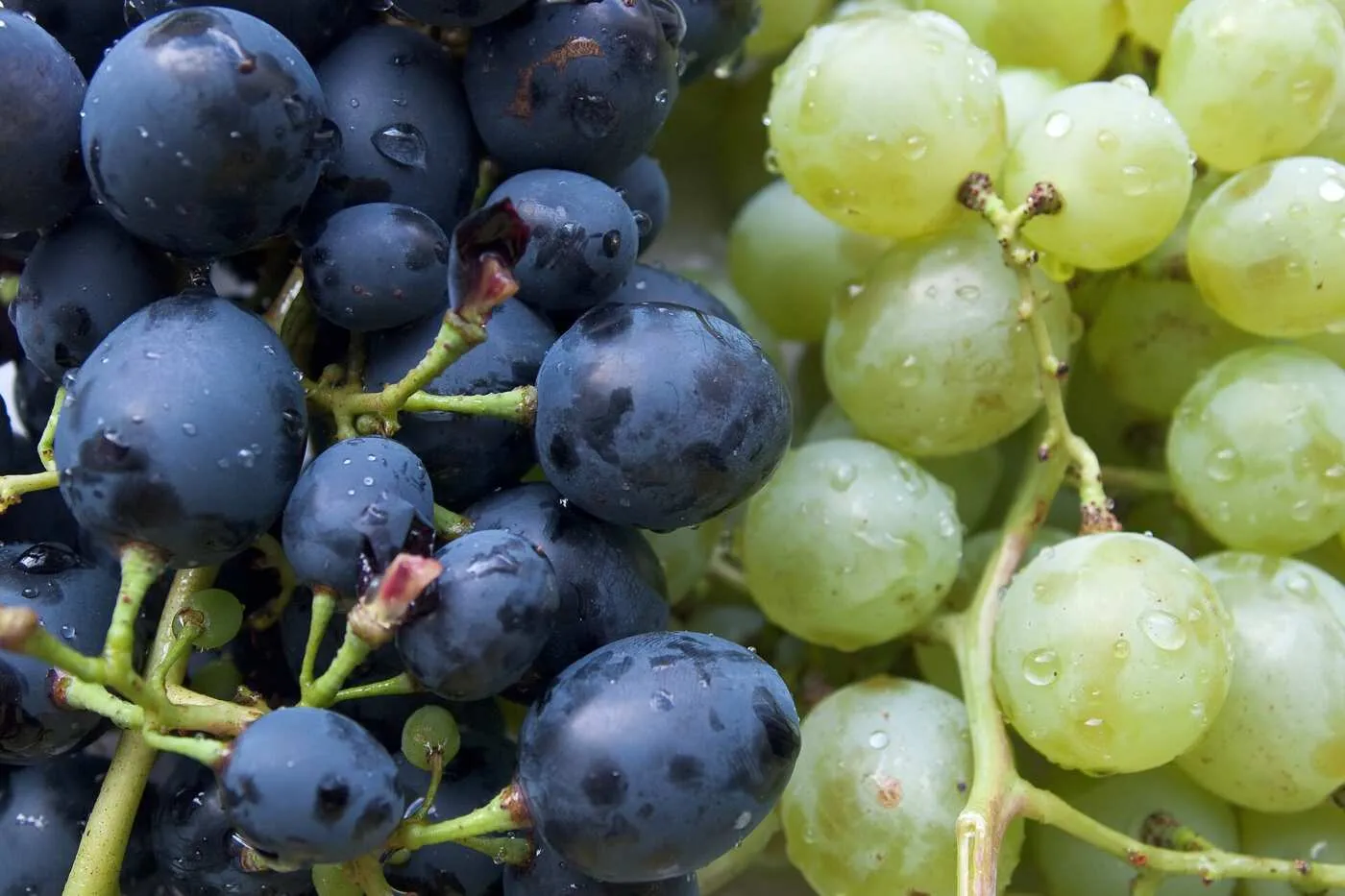 Photo: Vyacheslav Argenberg, CC BY 4.0, via Wikimedia Commons
A standard serving is about 150 g (roughly a cup, or 15–20 grapes), providing around 104 kcal and 23 g of sugar. Dark-skinned varieties carry substantially more anthocyanin than green ones, and since the polyphenols sit in the skin, peeling removes most of what distinguishes grapes from any other sweet fruit. Seeded varieties contain the proanthocyanidin fraction that seedless ones largely lack, though seeds are rarely eaten.
Freezing whole grapes produces a slow-eaten snack, which partially addresses the satiety problem. Grape juice retains most skin polyphenols if pressed with skins but loses what little fiber the whole fruit has, and concentrates sugar into a form that is drunk rather than chewed — a nutritionally worse trade than the polyphenol retention repays. Raisins are useful in cooking and for endurance-sport carbohydrate, and are a poor default snack for anyone managing blood glucose.
Grapes appear across the anti-inflammatory pantry and pair naturally with the polyphenol-dense foods discussed in Heart Health Superfoods.
Safety, Interactions, and Contraindications
Glycemic load: Grapes have a low-to-moderate glycemic index (measured values of about 43–59, with raisins and sultanas around 56–64; Atkinson et al., 2008) but are easily over-consumed, and their low fiber content offers little restraint on the glycemic response. People managing type 2 diabetes should treat grapes as a measured portion rather than a free food, and raisins more cautiously still.
Choking hazard: Whole grapes are a recognised cause of airway obstruction in young children, and their size and shape make them well suited to blocking a child’s airway (Lumsden and Cooper, 2017). For young children they should be cut lengthwise into halves or quarters rather than served whole.
Pesticide residue: Conventionally grown grapes often carry detectable pesticide residues, and the skin, where residues sit, is eaten. Organic grapes are a defensible choice for anyone eating them frequently, though the health consequence of residue at typical exposure levels is not established.
Drug interactions: Grape juice is not known to share the strong CYP3A4 and P-glycoprotein inhibition of furanocoumarin-rich grapefruit juice (Chen et al., 2018), and the two should not be treated as equivalent — see grapefruit, where the interaction is clinically significant and the list of affected medications is long. Grape juice is not free of interactions, though: in a crossover study of 12 healthy men, 200 mL of purple grape juice taken with cyclosporine lowered the drug’s exposure (AUC) by 30% (Oliveira-Freitas et al., 2010), so transplant patients should not take cyclosporine with it. Grape seed and skin extracts inhibit platelet function in laboratory studies (Vitseva et al., 2005), and small trials found that drinking purple grape juice daily for one to two weeks reduced platelet aggregation measured ex vivo (Keevil et al., 2000; Freedman et al., 2001); people on anticoagulants or antiplatelet drugs should raise supplemental use with their prescriber. Resveratrol supplements are a separate matter: 1 g a day for four weeks inhibited CYP3A4, CYP2D6 and CYP2C9 and induced CYP1A2 in healthy volunteers (Chow et al., 2010), a dose no diet supplies. Interaction data for whole grapes eaten in normal amounts are lacking.
Renal considerations: The National Kidney Foundation lists grapes and grape juice among lower-potassium fruits (under 200 mg per half-cup serving) and raisins among higher-potassium ones (NKF); anyone under active dietary restriction for chronic kidney disease should confirm portions with their renal dietitian.
Frequently Asked Questions
Are grapes good for you?
In measured portions, yes. Grapes provide vitamin K, copper and skin polyphenols such as anthocyanins, and pooled trials of red wine polyphenols suggest a small effect on systolic blood pressure. They are also high in sugar and low in fiber, so they are easy to overeat. Dark-skinned grapes carry more anthocyanins than green ones.
Do grapes have fiber?
Very little. Raw grapes contain about 0.9 g of fiber per 100 g, compared with 2.4 g for apples with skin and for blueberries, according to USDA data. Raisins have more fiber by weight, about 4.5 g per 100 g, but drying concentrates the sugar as well, to about 65 g per 100 g.
Are grapes good for diabetics?
Grapes can fit a diabetes meal plan as a measured portion rather than a free food. Their glycemic index is low to moderate, with measured values of about 43 to 59, but sugar makes up over 85% of their carbohydrate and fiber is low. Raisins call for more caution. A dietitian or clinician can help set a suitable portion.
How many grapes is too much?
There is no fixed limit, but a standard serving is about 150 g, roughly a cup or 15 to 20 grapes, providing about 104 kcal and 23 g of sugar. Because grapes give little satiety per calorie, it is easy to eat several servings at once. Freezing them slows eating, and people on potassium-restricted kidney diets should confirm portions with their dietitian.
Are grapes a berry?
Botanists generally classify the grape as a true berry: a fleshy fruit described as developing from a single ovary with its seeds inside, borne in clusters on a woody vine. The label is about plant structure, not nutrition. In everyday use grapes are grouped apart from culinary berries such as blueberries, and USDA data show they carry far less fiber, about 0.9 g per 100 g against 2.4 g.
Is red wine as healthy as grapes?
Not for the reasons often claimed. The resveratrol argument fails on dose: red wine averages about 0.3 mg of resveratrol per glass, while human trials have used 150 mg a day or more, and oral bioavailability is under 1%. Any cardiovascular effect of grapes is unlikely to come from resveratrol, and wine also brings alcohol.
References
Show all 24 referencesShow fewer
- Weaver, S. R., Rendeiro, C., McGettrick, H. M., Philp, A., & Lucas, S. J. E. (2021). Fine wine or sour grapes? A systematic review and meta-analysis of the impact of red wine polyphenols on vascular health. European Journal of Nutrition, 60(1), 1–28.
- Cassidy, A., Mukamal, K. J., Liu, L., Franz, M., Eliassen, A. H., & Rimm, E. B. (2013). High anthocyanin intake is associated with a reduced risk of myocardial infarction in young and middle-aged women. Circulation, 127(2), 188–196.
- Krikorian, R., Nash, T. A., Shidler, M. D., Shukitt-Hale, B., & Joseph, J. A. (2010). Concord grape juice supplementation improves memory function in older adults with mild cognitive impairment. British Journal of Nutrition, 103(5), 730–734.
- Walle, T., Hsieh, F., DeLegge, M. H., Oatis, J. E., & Walle, U. K. (2004). High absorption but very low bioavailability of oral resveratrol in humans. Drug Metabolism and Disposition, 32(12), 1377–1382.
- USDA FoodData Central. Grapes, red or green (European type, such as Thompson seedless), raw. U.S. Department of Agriculture.
- USDA FoodData Central. Raisins, dark, seedless. U.S. Department of Agriculture.
- Dong, Y., Duan, S., Xia, Q., et al. (2023). Dual domestications and origin of traits in grapevine evolution. Science, 379(6635), 892–901.
- McGovern, P., Jalabadze, M., Batiuk, S., et al. (2017). Early Neolithic wine of Georgia in the South Caucasus. Proceedings of the National Academy of Sciences, 114(48), E10309–E10318.
- Czank, C., Cassidy, A., Zhang, Q., et al. (2013). Human metabolism and elimination of the anthocyanin, cyanidin-3-glucoside: a (13)C-tracer study. American Journal of Clinical Nutrition, 97(5), 995–1003.
- Burns, J., Yokota, T., Ashihara, H., Lean, M. E. J., & Crozier, A. (2002). Plant foods and herbal sources of resveratrol. Journal of Agricultural and Food Chemistry, 50(11), 3337–3340.
- Stervbo, U., Vang, O., & Bonnesen, C. (2007). A review of the content of the putative chemopreventive phytoalexin resveratrol in red wine. Food Chemistry, 101, 449–457.
- Timmers, S., Konings, E., Bilet, L., et al. (2011). Calorie restriction-like effects of 30 days of resveratrol supplementation on energy metabolism and metabolic profile in obese humans. Cell Metabolism, 14(5), 612–622.
- Atkinson, F. S., Foster-Powell, K., & Brand-Miller, J. C. (2008). International tables of glycemic index and glycemic load values: 2008. Diabetes Care, 31(12), 2281–2283.
- Oliveira-Freitas, V. L., Dalla Costa, T., Manfro, R. C., Cruz, L. B., & Schwartsmann, G. (2010). Influence of purple grape juice in cyclosporine bioavailability. Journal of Renal Nutrition, 20(5), 309–313.
- Vitseva, O., Varghese, S., Chakrabarti, S., Folts, J. D., & Freedman, J. E. (2005). Grape seed and skin extracts inhibit platelet function and release of reactive oxygen intermediates. Journal of Cardiovascular Pharmacology, 46(4), 445–451.
- Keevil, J. G., Osman, H. E., Reed, J. D., & Folts, J. D. (2000). Grape juice, but not orange juice or grapefruit juice, inhibits human platelet aggregation. Journal of Nutrition, 130(1), 53–56.
- Freedman, J. E., Parker, C., Li, L., et al. (2001). Select flavonoids and whole juice from purple grapes inhibit platelet function and enhance nitric oxide release. Circulation, 103(23), 2792–2798.
- Chow, H. H., Garland, L. L., Hsu, C. H., et al. (2010). Resveratrol modulates drug- and carcinogen-metabolizing enzymes in a healthy volunteer study. Cancer Prevention Research, 3(9), 1168–1175.
- Stein, J. H., Keevil, J. G., Wiebe, D. A., Aeschlimann, S., & Folts, J. D. (1999). Purple grape juice improves endothelial function and reduces the susceptibility of LDL cholesterol to oxidation in patients with coronary artery disease. Circulation, 100(10), 1050–1055.
- Beher, D., Wu, J., Cumine, S., et al. (2009). Resveratrol is not a direct activator of SIRT1 enzyme activity. Chemical Biology & Drug Design, 74(6), 619–624.
- Hollman, P. C., Cassidy, A., Comte, B., et al. (2011). The biological relevance of direct antioxidant effects of polyphenols for cardiovascular health in humans is not established. Journal of Nutrition, 141(5), 989S–1009S.
- Lumsden, A. J., & Cooper, J. G. (2017). The choking hazard of grapes: a plea for awareness. Archives of Disease in Childhood, 102(5), 473–474.
- Chen, M., Zhou, S. Y., Fabriaga, E., Zhang, P. H., & Zhou, Q. (2018). Food-drug interactions precipitated by fruit juices other than grapefruit juice: An update review. Journal of Food and Drug Analysis, 26(2S), S61–S71.
- National Kidney Foundation. Potassium and Your CKD Diet.
Related content
More in Fruits
- Apple (Malus domestica)
Are apples good for you? Apples supply pectin fiber and quercetin, and large cohort studies link regular intake to lower heart disease and diabetes risk.
- Avocado (Persea americana)
Is avocado good for you? Avocado is high in monounsaturated fat, fiber and potassium, and small trials link a daily avocado to lower LDL cholesterol.
- Banana (Musa acuminata)
Are bananas good for you? Bananas supply potassium, vitamin B6 and fiber, and green bananas add resistant starch. The evidence, and who should limit them.
- Cherry (Prunus avium / Prunus cerasus)
Tart cherry juice benefits, weighed: small trials suggest faster muscle recovery and longer sleep, and gout data are early. Sweet vs tart cherry nutrition.
- Grapefruit (Citrus × paradisi)
Is grapefruit good for you? It is low in calories and rich in vitamin C, but it interacts with statins and 85+ other drugs. Benefits, nutrition and risks.
- Kiwi (Actinidia deliciosa)
Is kiwi good for you? Kiwifruit has more vitamin C than orange, plus fiber and vitamin K, and trials show two kiwis a day can ease constipation.

Curated by Superfoods Advisor Editors·Last updated