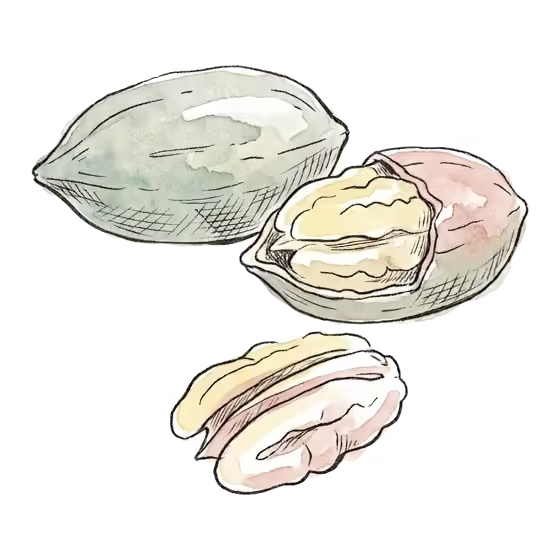
Pecans (Carya illinoinensis)
Carya illinoinensis · also known as pecan nut, Illinois nut, sweet pecan
By Superfoods Advisor Editors·July 3, 2026
Pecans vs walnuts compared on fat, omega-3, protein and evidence, plus pecans benefits and nutrition: cholesterol trials, serving size and allergy.
Pecans (Carya illinoinensis) are North American tree nuts in the walnut family, Juglandaceae. Compared with walnuts, they are higher in monounsaturated fat and proanthocyanidins but have about one-ninth the omega-3 ALA and less protein. A 28 g serving, about 19 halves, provides roughly 196 kcal. Small crossover trials found pecan-enriched diets lowered LDL cholesterol.
The pecan is a deciduous hickory native to the south-central United States and northern Mexico, where it grows naturally in floodplain forests along the Mississippi, Ohio, and Rio Grande river systems. The word “pecan” derives from the Algonquian word pakan or pacane — used by indigenous peoples of the Great Lakes and Eastern Woodlands regions to describe nuts requiring a stone to crack — and related terms in other Algonquian languages. Native American peoples across the south-central United States gathered and traded pecans extensively; archaeological evidence of pecan consumption has been recovered from sites in the south-central United States dating back several thousand years. Pecans served as a critical caloric and fat source in the late-summer and autumn food cycles of numerous indigenous groups.
Commercial cultivation developed in the American South during the nineteenth century, after grafting allowed selected thin-shelled (“paper-shell”) cultivars to be propagated. Today the United States and Mexico together grow most of the world’s pecans; the main US growing regions are Georgia, New Mexico, Texas, and the Mississippi delta. Pecans are the only major tree nut species indigenous to North America and are positioned as a premium ingredient in American regional cuisines. From a nutritional standpoint, pecans are distinguished by their proanthocyanidin, ellagitannin, and gamma-tocopherol content and by their balance of oleic acid and micronutrients including zinc and manganese.
Evidence at a glance
Active Compounds
Proanthocyanidins (PACs): Pecans contain among the highest concentrations of condensed proanthocyanidins (PACs) among tree nuts, measured at approximately 494 mg/100 g in a USDA analysis of common foods (Gu et al., 2004), close to the hazelnut value in the same survey. These polymeric flavanols — primarily composed of catechin and epicatechin subunits in B-type linkages — are concentrated in the papery brown skin (testa) of the pecan kernel. PACs have demonstrated antioxidant, anti-inflammatory, and vasoprotective activities in vitro and in animal studies; their bioavailability in humans is low but metabolites including valerolactones and phenylvaleric acids are detectable in urine and feces after nut consumption.
Ellagic acid and ellagitannins: Pecans contain ellagitannins — complex polyphenols that are hydrolyzed in the gut to release ellagic acid. Gut bacteria then convert ellagic acid to urolithins in stages: Gordonibacter species take it only as far as intermediates such as urolithin C (Selma et al., 2014), Enterocloster species carry out the final step to urolithin A (Pidgeon et al., 2025), and one Bifidobacterium pseudocatenulatum strain produced urolithins A and B from ellagic acid in the laboratory (Gaya et al., 2018). Urolithin A and urolithin B have attracted significant research interest for their potential roles in mitophagy activation, mitochondrial quality control, and anti-inflammatory signaling. Purified urolithin A has been tested in small randomized trials for effects on muscle endurance, mitochondrial markers, and inflammatory biomarkers such as C-reactive protein (Liu et al., 2022; Singh et al., 2022). Urolithin production is highly variable among individuals due to gut microbiome composition. In one study of 127 adults given an ellagitannin-containing extract, fewer than 2% produced no urolithins (metabotype 0), while about 46% (metabotype B) produced mainly isourolithin A and urolithin B rather than urolithin A (Iglesias-Aguirre et al., 2023).
Oleic acid: Roughly 59% of pecan fatty acids are oleic acid (C18:1n-9) (USDA FoodData Central), the fatty acid that dominates the MUFA-rich diets studied for cardiovascular health. Pecans have a somewhat higher polyunsaturated fat content than hazelnuts or macadamia nuts (~30% of fatty acids as linoleic acid), placing them nutritionally between the highest-MUFA nuts and high-PUFA nuts such as walnuts.
Tocopherols — predominantly gamma-tocopherol: Unlike hazelnuts (where alpha-tocopherol dominates), pecans’ vitamin E complement is overwhelmingly gamma-tocopherol, with only small amounts of alpha-, beta-, and delta-tocopherol. Total tocopherol content is approximately 27 mg/100 g, of which gamma-tocopherol accounts for about 24 mg/100 g and alpha-tocopherol about 1.4 mg (USDA FoodData Central). In laboratory experiments, gamma-tocopherol traps reactive nitrogen species such as those derived from peroxynitrite, complementing alpha-tocopherol (Christen et al., 1997).
Zinc: Pecans provide approximately 4.5 mg zinc per 100 g (~41% DV; USDA FoodData Central), among the higher levels in tree nuts. Zinc is essential for immune function, wound healing, DNA synthesis, and as a cofactor for numerous enzymes including Cu/Zn-superoxide dismutase.
Manganese: At approximately 4.5 mg/100 g (~196% DV; USDA FoodData Central), pecans are an excellent manganese source. Manganese is a cofactor for arginase, pyruvate carboxylase, and MnSOD, the primary mitochondrial antioxidant enzyme.
Phytosterols: Beta-sitosterol, campesterol, and stigmasterol are present in pecan fat and may compete with cholesterol for intestinal absorption through micellar displacement, potentially contributing to modest LDL cholesterol reduction.
Nutritional Profile
Per 100 g of raw pecans (USDA FoodData Central, FDC ID 170182):
| Nutrient | Amount | % DV |
|---|---|---|
| Energy | 691 kcal | — |
| Protein | 9.2 g | — |
| Total fat | 72.0 g | — |
| — Saturated fat | 6.2 g | — |
| — Monounsaturated fat | 40.8 g (~59% of fatty acids) | — |
| — Polyunsaturated fat | 21.6 g | — |
| — Omega-6 (linoleic) | ~20.6 g | — |
| — Omega-3 (ALA) | ~1.0 g | — |
| Carbohydrates | 13.9 g | — |
| Dietary fiber | 9.6 g | — |
| Vitamin E (total tocopherols) | ~27 mg (24.4 mg gamma) | — |
| Manganese | 4.5 mg | 196% |
| Zinc | 4.5 mg | 41% |
| Copper | 1.2 mg | 133% |
| Magnesium | 121 mg | 29% |
| Phosphorus | 277 mg | 22% |
| Potassium | 410 mg | 9% |
| Thiamine (B1) | 0.66 mg | 55% |
| Iron | 2.5 mg | 14% |
| Calcium | 70 mg | 5% |
| Proanthocyanidins | ~494 mg (Gu et al., 2004) | — |
Pecans vs Walnuts: How Do They Compare?
Pecans and walnuts are botanical cousins with different fat profiles: pecans lean monounsaturated, walnuts polyunsaturated and rich in omega-3. Walnuts have more protein and a larger trial base; pecans have more fiber, manganese and zinc. Per 100 g (USDA FoodData Central: pecans, walnuts):
| Per 100 g | Pecans | Walnuts |
|---|---|---|
| Energy | 691 kcal | 654 kcal |
| Protein | 9.2 g | 15.2 g |
| Monounsaturated fat | 40.8 g | 8.9 g |
| Polyunsaturated fat | 21.6 g | 47.2 g |
| Omega-3 (ALA) | ~1.0 g | ~9.1 g |
| Dietary fiber | 9.6 g | 6.7 g |
| Manganese | 4.5 mg | 3.4 mg |
| Zinc | 4.5 mg | 3.1 mg |
| Gamma-tocopherol | ~24 mg | ~21 mg |
Research base: Walnuts have the stronger record, including a 26-trial meta-analysis and a two-year randomized trial showing LDL reductions. Pecan evidence rests on small crossover trials with similar direction of effect. Neither nut has been shown to reduce heart attacks on its own.
Practical difference: Pecans’ lower polyunsaturated fat makes them somewhat less prone to rancidity than walnuts. For plant omega-3, walnuts are the clear choice; for a sweeter, milder nut with more fiber, pecans. Their allergens cross-react strongly, so an allergy to one usually means avoiding both.
Evidence for Purported Benefits
Cardiovascular Risk and Lipid Reduction
Evidence:Moderate Small crossover trials consistently lowered LDL and oxidized LDL; no event trials.
Pecans’ cardiovascular benefits have been examined in several controlled trials. A randomized crossover trial by Rajaram et al. (Journal of Nutrition, 2001) in 23 adults with normal-to-mildly-elevated cholesterol found that a pecan-enriched diet (pecans replacing 20% of energy, each diet followed for 4 weeks) reduced total cholesterol by 6.7%, LDL by 10.4%, and triglycerides by 11.1% beyond the American Heart Association Step I diet, while raising HDL slightly (by 2.5 mg/dL), without weight gain. A later crossover trial by Hudthagosol et al. (Journal of Nutrition, 2011) in 16 healthy adults found that oxidized LDL fell by 26–33% between 2 and 8 hours after a single whole-pecan test meal. These findings are mechanistically consistent with oleic acid’s displacement of saturated fat, gamma-tocopherol’s antioxidant activity in LDL particles, and phytosterol-mediated cholesterol absorption reduction.
Antioxidant Capacity — ORAC and Biomarkers
Evidence:Preliminary One small acute crossover trial of antioxidant biomarkers; clinical relevance unknown.
Pecans score high on the in-vitro ORAC (Oxygen Radical Absorbance Capacity) assay, but ORAC measures test-tube activity only, and the USDA withdrew its ORAC database in 2012 because such values do not reflect effects in the body. More clinically meaningful are trials measuring plasma antioxidant capacity and oxidized LDL in humans. Hudthagosol et al. (2011) found that a pecan meal doubled plasma gamma-tocopherol concentrations at 8 hours and raised plasma ORAC by 10–12% at 2 hours while decreasing oxidized LDL — a more biologically relevant endpoint than ORAC. The proanthocyanidin content may contribute to these effects, though PAC bioavailability from pecans in humans remains incompletely characterized.
Urolithin Production and Mitochondrial Health
Evidence:Insufficient No pecan studies; the human data come from purified urolithin A supplements.
The ellagitannin-to-urolithin conversion pathway observed with pomegranate and walnut consumption is also theoretically operative with pecan consumption, given their ellagic acid content. In a first-in-human trial (Andreux et al., Nature Metabolism, 2019), urolithin A given to healthy sedentary older adults for four weeks was well tolerated and, at 500 and 1,000 mg/day, modulated plasma acylcarnitines and skeletal-muscle mitochondrial gene expression. However, these trials used purified urolithin A supplements rather than food sources. Whether pecan consumption generates sufficient urolithin precursor to produce clinically meaningful urolithin concentrations — and whether individual conversion capacity from gut microbiome composition is adequate — requires dedicated investigation.
Glycemic Control and Type 2 Diabetes Risk
Evidence:Preliminary Mixed observational data on nuts in general; pecan-specific trials are sparse.
Observational findings are mixed. In the Nurses’ Health Study, women who ate nuts more often had a lower risk of developing type 2 diabetes after adjustment for body mass index, physical activity, and energy intake (Jiang et al., 2002), but a 2021 meta-analysis of cohort and cross-sectional studies found no significant association for total nuts or tree nuts, rating the evidence very low certainty (Becerra-Tomás et al., 2021). Pecans were not analysed separately. Mechanistic explanations include reduced postprandial glycemia from fiber and fat slowing gastric emptying, magnesium’s role as a cofactor for insulin receptor kinase, and potential modulation of gut microbiota composition. However, pecan-specific glycemic intervention data are sparse, and the observational data do not establish causality.
Position in Mediterranean-Style Dietary Patterns
Pecans, while native to North America rather than the Mediterranean basin, share the MUFA-dominant fatty acid profile, fiber content, and polyphenol richness that characterize the nuts recommended within Mediterranean-style dietary patterns (the PREDIMED trial, which supplied walnuts, hazelnuts, and almonds, reported fewer major cardiovascular events with a nut-supplemented Mediterranean diet; Ros et al., 2014). Mediterranean diet scoring systems generally count nuts as one group, and pecans fit naturally into these patterns as an American-grown complement or substitute for walnuts or almonds.
Typical Use and Preparation
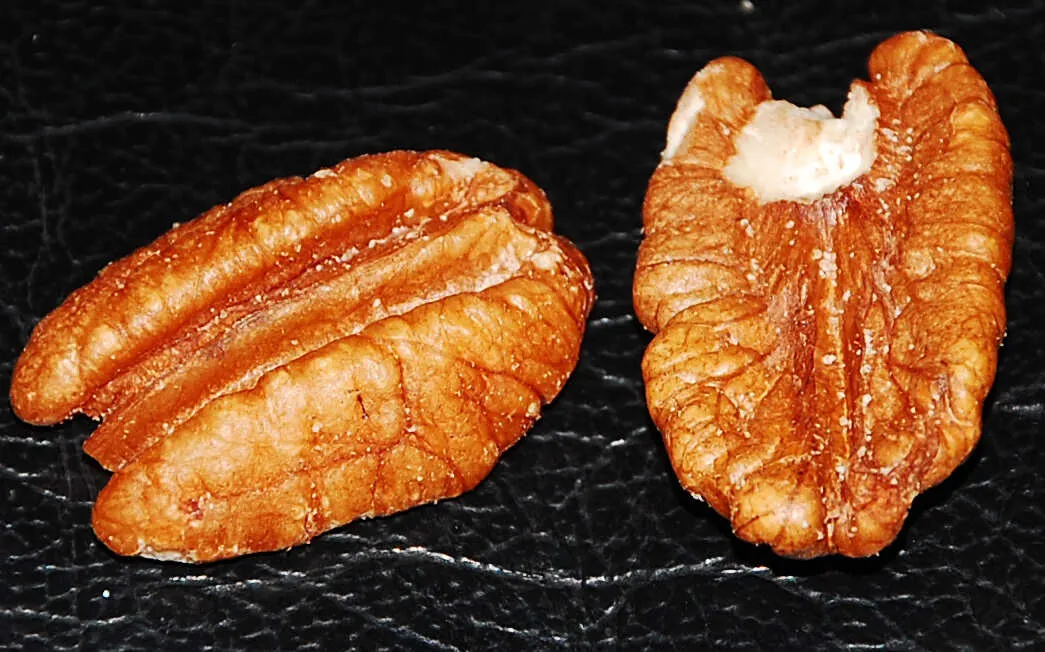 Photo: Bubba73, CC BY-SA 3.0, via Wikimedia Commons
Pecans are consumed raw, roasted, or candied, and are prominent in American Southern cooking — pecan pie, pralines, pecan-crusted poultry, and baked goods are characteristic preparations. They are also used in trail mixes, salads, and cheese boards.
Roasting: Pecans are typically dry-roasted at 150–170°C for 8–12 minutes. Their moderate polyunsaturated fat content (~30% of fatty acids) means linoleic acid in pecan fat is susceptible to oxidative degradation at roasting temperatures, particularly above 170°C. Light roasting is preferred for flavor development; heavy roasting risks generating lipid oxidation products (aldehydes, malondialdehyde). Gamma-tocopherol helps protect against oxidative rancidity during roasting, but is consumed in the process.
Raw pecans: Retain the highest PAC and phenolic acid content when the pellicle (papery skin) is intact. Commercial pecan halves and pieces are typically sold with skins intact, unlike blanched almonds or hazelnuts.
Candied pecans: Sugar-coated or syrup-coated preparations add substantial sucrose (and often saturated fat from butter), substantially altering the nutritional profile relative to raw or dry-roasted pecans. Consumers comparing health claims should distinguish the nut from the confection.
A 1 oz (28 g, ~19 halves) serving provides approximately 196 kcal, 2.6 g protein, 20.4 g fat (11.6 g MUFA), and 2.7 g fiber (USDA FoodData Central).
For the wider nut evidence, including the PREDIMED trial’s Mediterranean diet with mixed nuts, see the guide to foods for heart health.
Safety, Interactions, and Contraindications
Tree nut allergy: Characterized pecan allergens include Car i 1 (a 2S albumin), Car i 2 (a 7S vicilin), and Car i 4 (an 11S legumin, homologous to hazelnut Cor a 9); Car i 1 stays soluble through roasting while Car i 4 is more heat-labile (Brown et al., 2025). Pecan allergy can be severe, including systemic anaphylaxis; it is frequently associated with walnut allergy, as pecans and walnuts are both Juglandaceae members and share cross-reactive protein families. Walnut and pecan are highly cross-reactive, and guidelines have generally advised avoiding all tree nuts once one tree nut allergy is diagnosed (Smeekens et al., 2018). In the US, labels must name the specific tree nut, such as pecans (FDA); the EU lists pecan nuts among its mandatory-labeling allergens (Regulation (EU) No 1169/2011, Annex II).
Warfarin (anticoagulant) interaction: Pecans and other nuts contain vitamin K at low but measurable levels. Individuals on warfarin therapy should maintain consistent vitamin K intake; large changes in nut consumption could theoretically affect INR stability, though the typical serving amounts of pecans are unlikely to be clinically problematic. Clinicians should be aware of this in patients with highly variable diets.
Phytate and mineral bioavailability: Like other tree nuts, pecans contain phytic acid (inositol hexaphosphate), which can bind divalent minerals including zinc, calcium, and iron and reduce their absorption. The nutritional values in the table reflect total mineral content; net absorbed fractions will be lower due to phytate and other antinutrients.
Caloric density: At 691 kcal/100 g, pecans are highly energy-dense. Standard portion sizes of 28 g (~20 pecan halves) provide approximately 196 kcal, which should be accounted for within total energy intake.
This entry is for informational purposes only and does not constitute medical advice, diagnosis, or treatment.
Frequently Asked Questions
Which is healthier, pecans or walnuts?
Neither wins outright. Walnuts supply about nine times more ALA omega-3 and more protein, and their cholesterol-lowering effect is backed by a larger body of trials. Pecans have more monounsaturated fat, fiber, manganese and proanthocyanidins, and small trials suggest they lower LDL cholesterol too. Eating either, in place of snacks high in saturated fat, is the change the trials actually tested.
Are pecans good for you?
In normal portions, pecans are a nutrient-dense food rich in monounsaturated fat, fiber, manganese, zinc and polyphenols. In a crossover trial of 23 adults, replacing 20% of energy with pecans lowered LDL cholesterol by 10.4% more than a standard heart-healthy diet. The evidence base is small, and candied pecans or pecan pie carry enough added sugar to change the picture.
How many pecans should you eat per day?
A standard serving is 28 g, about 19 to 20 halves, which supplies roughly 196 kcal. The cholesterol trial used much more, with pecans providing 20% of daily energy. No official limit exists; at 691 kcal per 100 g, the main reason to portion pecans is calorie balance.
Are pecans good for people with diabetes?
The evidence is preliminary. Pecans are low in carbohydrate (13.9 g per 100 g, with 9.6 g fiber), so they cause little rise in blood sugar. A large cohort linked frequent nut eating to lower diabetes risk in women, but a 2021 meta-analysis found no clear association for nuts overall, and pecans have not been studied separately.
Are pecans a tree nut?
Yes. Pecans are tree nuts and must be named on US food labels; the EU also lists pecan nuts among mandatory allergens. Pecan allergy can cause anaphylaxis and is strongly cross-reactive with walnut allergy, because both nuts belong to the same plant family. Anyone with a tree nut allergy should check with an allergist before eating pecans.
References
Show all 19 referencesShow fewer
- Rajaram, S., Burke, K., Connell, B., Myint, T., & Sabaté, J. (2001). A monounsaturated fatty acid–rich pecan-enriched diet favorably alters the serum lipid profile of healthy men and women. Journal of Nutrition, 131(9), 2275–2279.
- Hudthagosol, C., Haddad, E. H., McCarthy, K., Wang, P., Oda, K., & Sabaté, J. (2011). Pecans acutely increase plasma postprandial antioxidant capacity and catechins and decrease LDL oxidation in humans. Journal of Nutrition, 141(1), 56–62.
- Andreux, P. A., Blanco-Bose, W., Ryu, D., Burdet, F., Ibberson, M., Aebischer, P., … Rinsch, C. (2019). The mitophagy activator urolithin A is safe and induces a molecular signature of improved mitochondrial and cellular health in humans. Nature Metabolism, 1(6), 595–603.
- Gu, L., Kelm, M. A., Hammerstone, J. F., Beecher, G., Holden, J., Haytowitz, D., & Prior, R. L. (2004). Concentrations of proanthocyanidins in common foods and estimations of normal consumption. Journal of Nutrition, 134(3), 613–617.
- Ros, E., Martínez-González, M. A., Estruch, R., Salas-Salvadó, J., Fitó, M., Martínez, J. A., & Corella, D. (2014). Mediterranean diet and cardiovascular health: Teachings of the PREDIMED study. Advances in Nutrition, 5(3), 330S–336S.
- USDA FoodData Central. (2019). Nuts, pecans. FDC ID 170182. U.S. Department of Agriculture.
- Iglesias-Aguirre, C. E., Romo-Vaquero, M., Selma, M. V., & Espín, J. C. (2023). Unveiling metabotype clustering in resveratrol, daidzein, and ellagic acid metabolism: Prevalence, associated gut microbiomes, and their distinctive microbial networks. Food Research International, 173(Pt 2), 113470.
- Selma, M. V., Beltrán, D., García-Villalba, R., Espín, J. C., & Tomás-Barberán, F. A. (2014). Description of urolithin production capacity from ellagic acid of two human intestinal Gordonibacter species. Food & Function, 5(8), 1779–1784.
- Pidgeon, R., Mitchell, S., Shamash, M., Suleiman, L., Dridi, L., Maurice, C. F., & Castagner, B. (2025). Diet-derived urolithin A is produced by a dehydroxylase encoded by human gut Enterocloster species. Nature Communications, 16(1), 999.
- Gaya, P., Peirotén, Á., Medina, M., Álvarez, I., & Landete, J. M. (2018). Bifidobacterium pseudocatenulatum INIA P815: The first bacterium able to produce urolithins A and B from ellagic acid. Journal of Functional Foods, 45, 95–99.
- Liu, S., D’Amico, D., Shankland, E., Bhayana, S., Garcia, J. M., Aebischer, P., Rinsch, C., Singh, A., … (2022). Effect of urolithin A supplementation on muscle endurance and mitochondrial health in older adults: A randomized clinical trial. JAMA Network Open, 5(1), e2144279.
- Singh, A., D’Amico, D., Andreux, P. A., Fouassier, A. M., Blanco-Bose, W., Evans, M., Aebischer, P., … (2022). Urolithin A improves muscle strength, exercise performance, and biomarkers of mitochondrial health in a randomized trial in middle-aged adults. Cell Reports Medicine, 3(5), 100633.
- Christen, S., Woodall, A. A., Shigenaga, M. K., Southwell-Keely, P. T., Duncan, M. W., & Ames, B. N. (1997). γ-Tocopherol traps mutagenic electrophiles such as NOx and complements α-tocopherol: Physiological implications. Proceedings of the National Academy of Sciences, 94(7), 3217–3222.
- Jiang, R., Manson, J. E., Stampfer, M. J., Liu, S., Willett, W. C., & Hu, F. B. (2002). Nut and peanut butter consumption and risk of type 2 diabetes in women. JAMA, 288(20), 2554–2560.
- Becerra-Tomás, N., Paz-Graniel, I., Hernández-Alonso, P., Jenkins, D. J. A., Kendall, C. W. C., Sievenpiper, J. L., & Salas-Salvadó, J. (2021). Nut consumption and type 2 diabetes risk: A systematic review and meta-analysis of observational studies. American Journal of Clinical Nutrition, 113(4), 960–971.
- Brown, C. N., Dupre, R. A., Ebmeier, C. C., Patil, S., Smith, B., & Mattison, C. P. (2025). Heating differentiates pecan allergen stability: Car i 4 is more heat labile than Car i 1 and Car i 2. Food Science & Nutrition, 13(2), e4747.
- Smeekens, J. M., Bagley, K., & Kulis, M. (2018). Tree nut allergies: Allergen homology, cross-reactivity, and implications for therapy. Clinical & Experimental Allergy, 48(7), 762–772.
- U.S. Food and Drug Administration. Food Allergies.
- Regulation (EU) No 1169/2011 on the provision of food information to consumers, Annex II.
More in Nuts & Seeds
- Almonds (Prunus dulcis)
Almonds benefits and nutrition: what trials show for LDL cholesterol, blood sugar and weight, plus serving size, vitamin E, oxalate and allergy risks.
- Brazil Nuts (Bertholletia excelsa)
Brazil nuts benefits come down to selenium: one nut can hold 8 to 200 mcg. How many to eat per day, what the research shows, and the toxicity limit.
- Cashews (Anacardium occidentale)
Cashews benefits and nutrition: copper, magnesium and iron per serving, what trials show for blood pressure and blood sugar, and allergy and oxalate risks.
- Chia Seeds (Salvia hispanica)
How to eat chia seeds: soaked, ground or in pudding, with serving size, nutrition and what trials show for blood sugar, blood pressure and weight loss.
- Flaxseed (Linum usitatissimum)
Flaxseed benefits explained: what trials show for blood pressure, cholesterol and constipation, why ground beats whole, daily amounts and side effects.
- Hazelnuts (Corylus avellana)
Hazelnuts benefits and nutrition: oleic acid, vitamin E and folate per serving, what trials show for cholesterol, and how birch-pollen allergy works.

Curated by Superfoods Advisor Editors·Last updated