The Best Mushroom Coffee, Ranked on What's Actually in the Cup (2026)
By Superfoods Advisor Editors·October 23, 2026
Updated October 23, 2026Top-ranked
 Check price on Amazon on Amazon for Four Sigmatic Focus Instant Mushroom Coffee, 30 Servings (opens in a new tab)
 Check price on Amazon on Amazon for Everyday Dose Mushroom Coffee+ (Mild Roast), 30 Servings (opens in a new tab)
 Check price on Amazon on Amazon for Laird Superfood Peruvian Medium Roast Coffee with Functional Mushrooms, 12 oz (opens in a new tab)
Compare all 5 picks →Affiliate links. Disclosure.
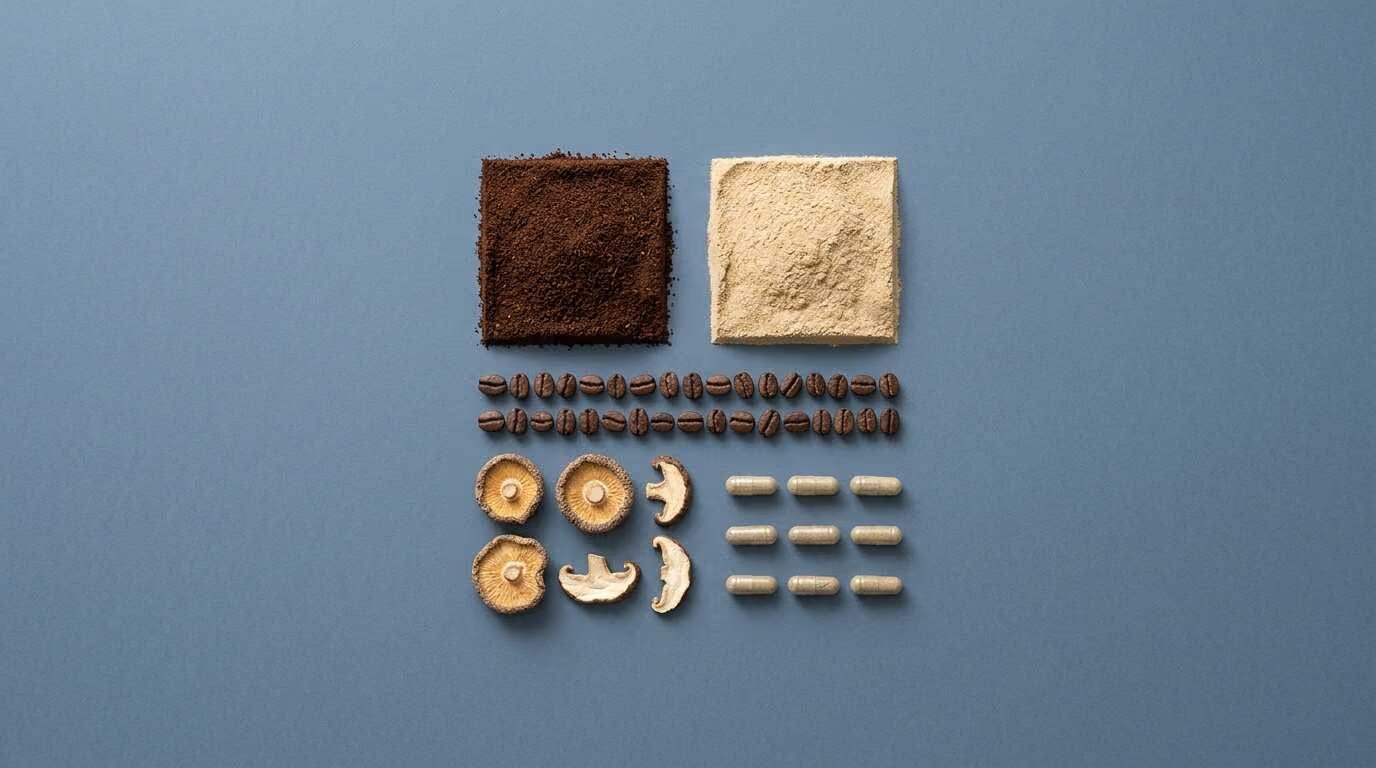
The best mushroom coffee, RYZE included, compared on fruiting body vs. mycelium, mushroom mg per cup, caffeine and labels. Top-ranked: Four Sigmatic.
Top-ranked · 5 products compared
We earn a commission on purchases made through these links. It does not affect our rankings. See our affiliate disclosure.
| # | Product | Score | Details |
|---|---|---|---|
| 1 | | ||
| 2 | | ||
| 3 | Laird Superfood Laird Superfood Peruvian Medium Roast Coffee with Functional Mushrooms, 12 ozBest ground coffee | ||
| 4 |  | ||
| 5 |  Om Mushroom Superfood Om Mushroom Superfood Medium Roast Instant Black Coffee, 30 ServingsBest for in-house sourcing |
1Four Sigmatic
Four Sigmatic Focus Instant Mushroom Coffee, 30 Servings
The only pick that gives each mushroom its own dose: 250 mg apiece of fruiting body lion's mane and chaga, with caffeine lab-tested to 50 mg a cup. That is well below trial doses, and the label is specific enough to show it.
Strengths
- States 250 mg lion's mane and 250 mg chaga per serving
- Fruiting body only, per the brand
- Caffeine batch-tested at 50 mg; organic, fair trade coffee
Trade-offs
- 250 mg lion's mane is a fraction of trial doses
- Beta-glucan content not printed on the listing
Four Sigmatic does what most mushroom coffees avoid. The listing gives 250 mg of organic lion's mane and 250 mg of chaga per serving as separate figures, plus a rhodiola extract, instead of one proprietary total. The brand says it uses only fruiting bodies, no mycelium, and that each batch of the instant coffee is third-party lab tested so a serving delivers 50 mg of caffeine, about half a typical cup. The coffee is organic and fair trade.
Those numbers also show the limit. 250 mg of lion's mane is roughly a seventh of the 1.8 g single dose used by Docherty et al. (2023, Nutrients) and about a twelfth of the roughly 3 g daily intake in Mori et al. (2009, Phytotherapy Research). No beta-glucan percentage is printed, so you can't judge the extract's strength per milligram from the label.
The listing averages about 4.2 stars from roughly 800 ratings. A r/MushroomCoffee comparison of RYZE and Four Sigmatic puts the trade-off plainly: Four Sigmatic tastes like coffee with mushrooms added, coffee downsides included, while RYZE tastes earthier. Treat it as a well-documented instant coffee with half the caffeine. As a lion's mane supplement it falls short.
2Everyday Dose
Everyday Dose Mushroom Coffee+ (Mild Roast), 30 Servings
The most mushroom per cup in this group, around 1,500 mg of fruiting body lion's mane and chaga by the brand's count, plus L-theanine. Held back by a proprietary blend that hides the split, and bovine collagen rules out vegans.
Strengths
- About 1,500 mg fruiting body lion's mane and chaga
- Double-extracted fruiting body, per the listing
- 45 mg caffeine paired with L-theanine
Trade-offs
- Proprietary blend; no per-mushroom figure
- Contains bovine collagen, so not vegan
Everyday Dose calls its mushrooms 100% fruiting body, double-extracted, and its product page gives roughly 1,500 mg of lion's mane and chaga combined per serving. Collagen, L-theanine and a cold-brew coffee extract with 45 mg of caffeine make up the rest. No other product here has more mushroom per serving, and none gets closer to the gram-range doses used in lion's mane trials.
The catch is the label. The supplement panel is one proprietary blend, so the lion's mane share isn't stated; a 2026 review by Mushroom Coffee Lab lists it as not disclosed. An even split would put lion's mane near 750 mg, but that's our arithmetic, not the label's. The better-supported ingredient is the L-theanine: a Payne et al. (2025, Nutrition Reviews) meta-analysis found small-to-moderate short-term effects of theanine plus caffeine on some attention measures, with wide uncertainty. The collagen is bovine, so vegetarians and vegans should skip it.
The listing averages about 4.5 stars across roughly 9,600 ratings. Reddit is split on taste and value. A r/latteart 60-day review found the flavor earthy rather than coffee-like. A long-running r/MushroomSupplements thread mixes skepticism about the marketing with drinkers who like it as a lighter coffee.
3Laird Superfood
Laird Superfood Peruvian Medium Roast Coffee with Functional Mushrooms, 12 oz
Real ground coffee for a drip machine or pour-over, with fruiting body mushroom extracts per the brand. The mushroom dose is small, about 500 mg of blend per 10 g serving, and the caffeine is full strength.
Strengths
- Ground beans for drip, pour-over and espresso
- Organic Peruvian coffee; Fair Trade badge on the listing
- Brand states its extracts use the fruiting body
Trade-offs
- Only about 500 mg of blend per 10 g serving
- Full-strength caffeine, about 100 mg per serving
Laird is for readers who want to keep brewing real coffee. It's a medium-fine grind of organic Peruvian beans for drip, pour-over or espresso, with chaga, lion's mane and cordyceps listed on Amazon (Laird's own page adds maitake). In answers on its product page, Laird says its mushroom extracts use the fruiting body and that a 10 g serving carries about 500 mg of mushroom blend and about 100 mg of caffeine. The Amazon listing shows a Fair Trade Certified badge.
500 mg split across three or four species is a culinary amount, and 100 mg of caffeine is a normal cup. So this is the least "functional" product here and the most coffee-like. Laird's site also carries a California Proposition 65 notice for lead. Prop 65 notices don't state an amount and appear on many foods and supplements, but you should know about it. No beta-glucan figure or certificate of analysis is published.
The listing averages about 4.6 stars across roughly 1,250 ratings, mostly about flavor. A 2026 Serious Eats roundup of mushroom coffees also included it.
4RYZE Superfoods
RYZE Organic Mushroom Coffee, Medium Roast, 30 Servings
The best-known brand and the lowest-caffeine real coffee here at 48 mg. But six mushrooms share one 2,000 mg proprietary blend, and the brand's own description of its sourcing mixes fruiting body with mycelium grown on oats.
Strengths
- 48 mg caffeine, about half a standard cup
- USDA Organic; mushrooms grown in the USA
- Large review base, about 8,300 ratings
Trade-offs
- 2,000 mg blend split six ways, no per-mushroom mg
- Mixes fruiting body and mycelium grown on oats
You have probably seen the RYZE ads. The Amazon listing states 48 mg of caffeine per serving and a six-mushroom blend (cordyceps, king trumpet, lion's mane, reishi, shiitake, turkey tail) of 2,000 mg in total, USDA Organic and grown in the USA. It doesn't give per-mushroom amounts. An even split would put lion's mane near 330 mg, but the label doesn't confirm that.
RYZE calls its sourcing "full spectrum." Asked directly by Innerbody, the company said it grows its mushrooms "on logs and whole-grain, gluten-free oats," separates the mycelium from the substrate, and uses "full-spectrum mushrooms, including fruiting bodies." In plain terms, that's mycelium and fruiting body mixed, in proportions third-party write-ups disagree about. The listing mentions beta-glucans but gives no percentage.
The listing averages about 4.3 stars from roughly 8,300 ratings, and Amazon's review summary is mixed on health benefits. Reddit is blunter. A poster in an r/Supplements thread on mushroom coffee called the mushroom dose "laughably low," and commenters in r/WellnessOver30 and r/MushroomCoffee describe an earthy taste some can't get past. Buy it to halve your caffeine. Don't buy it for the mushrooms.
5Om Mushroom Superfood
Om Mushroom Superfood Medium Roast Instant Black Coffee, 30 Servings
Honest about being myceliated oats, and the only brand here that grows, dries and mills its own mushrooms. But the 2,000 mg 'mushroom' figure includes the oat substrate, and the listing does not print caffeine.
Strengths
- Ingredient list plainly says myceliated oats
- Grows, dries and mills its mushrooms in California
- USDA Organic; brand says each batch is third-party tested
Trade-offs
- 2,000 mg figure includes the oat substrate
- Caffeine per serving not printed on the listing
Om's ingredient list is two items: organic coffee powder and organic myceliated oats. Lion's mane and cordyceps mycelium are grown on oats, and the whole biomass, grain included, is dried and milled. Om says so openly, and it is the only brand here that grows, dries and mills its own mushrooms (in Southern California). The listing says each batch is third-party tested for purity and potency.
Read the headline numbers carefully. The listing claims a 2,000 mg mushroom blend with 400 mg of beta-glucans, but on a myceliated-oat product that weight includes the oat substrate, and oats carry their own cereal beta-glucan. A beta-glucan figure that doesn't say which kind can't tell you how much mushroom is in the scoop. The same problem drives the mycelium-on-grain debate in our lion's mane supplement roundup. There's no caffeine figure either.
The listing averages about 4.3 stars from roughly 670 ratings. In Amazon's review summary, most taste mentions are positive and most value-for-money mentions negative. It's a decent instant coffee from an honest producer. It ranks last because it has the least verifiable mushroom material per serving.
The best mushroom coffee in this comparison is Four Sigmatic Focus Instant, the only pick that states a dose for each mushroom: 250 mg apiece of fruiting body lion’s mane and chaga, with caffeine lab-tested at 50 mg a cup. Everyday Dose packs the most mushroom per cup, and RYZE ranks fourth because six mushrooms share one proprietary blend.
Mushroom coffee is ordinary coffee, usually instant, blended with powdered or extracted medicinal mushrooms such as lion’s mane, chaga, reishi and cordyceps. It sells on focus and “no-crash” energy. On current evidence, most of what you notice comes from two things a label can state exactly: the caffeine dose and any added L-theanine. The mushrooms usually show up at a fraction of the amounts used in human trials. We ranked five Amazon products on what the label and the brand’s own disclosures let you verify, then on customer sentiment.
How we chose
The ranking weighs, in order:
- Fruiting body vs. mycelium on grain. Fruiting-body extracts are measured mushroom material. Mycelium grown on oats or rice is dried with its grain substrate, so part of the weight is starch. The lion’s mane encyclopedia entry explains why this matters for the compounds studied in trials.
- Disclosed milligrams per mushroom. A separate figure for each species beats a proprietary total; “2,000 mg blend of six mushrooms” can’t be checked against a trial dose.
- Beta-glucan disclosure and third-party testing. A stated beta-glucan percentage, a published certificate of analysis or batch testing all count. None of the five prints a mushroom-specific beta-glucan percentage on its Amazon listing.
- Caffeine per serving, as a number.
- Certifications: USDA Organic, Fair Trade.
- Cost per serving, compared from listings at the time of writing. Prices change faster than this page, so they aren’t printed.
- Customer and Reddit sentiment: Amazon average and approximate rating count, plus threads in r/MushroomCoffee, r/Supplements, r/MushroomSupplements and r/JamesHoffmann. Ratings and counts were read in October 2026 and will drift.
We did not run lab assays. Every sourcing and dose figure comes from a label, a brand statement or a cited third-party review, attributed in each product’s write-up.
We excluded coffee alternatives with no coffee (MUD\WTR, chicory blends), multi-ingredient “nootropic” coffees where lion’s mane is one of many unlisted amounts, and no-name listings with “10-in-1” or “12-in-1” blends that state no source material.
What’s actually in a cup of mushroom coffee
Mushroom coffee is a coffee product. Compare the doses:
- Lion’s mane trials have used about 1.8 g as a single dose (Docherty et al. 2023, Nutrients, which reported faster Stroop performance 60 minutes after dosing in a small pilot of 41 adults, with null results on many other measures) and about 3 g a day for 16 weeks in older adults with mild cognitive impairment (Mori et al. 2009, Phytotherapy Research, 30 participants).
- A 2025 systematic review found the human evidence for lion’s mane promising but small, built from a handful of randomized and pilot trials (Menon et al. 2025, Frontiers in Nutrition).
- The products here deliver between about 250 mg of lion’s mane (Four Sigmatic, stated) and an undisclosed share of a 500 to 2,000 mg multi-mushroom blend.
Even the best-documented cup carries a small fraction of a studied dose, and we found no published trial of mushroom coffee itself. If you want lion’s mane at trial doses, take a dedicated fruiting-body extract; see the best lion’s mane supplements for focus. Chaga and reishi have even thinner human evidence for the benefits these products imply. Our chaga and reishi entries cover what is known, and what the research says about medicinal mushrooms covers the wider literature.
A note on caffeine
The effect you can measure in most of these products is caffeine, and the range is wide: 45 to 50 mg for Everyday Dose, RYZE and Four Sigmatic, about 100 mg per 10 g serving for Laird. For healthy adults, a large systematic review supported up to 400 mg of caffeine a day as not associated with adverse effects, with lower thresholds for pregnancy and adolescents (Wikoff et al. 2017, Food and Chemical Toxicology). Much of the “smoother, no-jitters” feeling in customer reviews is what you’d expect from drinking half the caffeine. If that’s what you’re after, compare caffeine figures first and mushroom claims second.
A note on health claims
Nothing on this page diagnoses, treats, prevents or cures any condition. Four cautions:
- Chaga is high in oxalate. Case reports describe oxalate kidney injury after long-term, high-intake chaga use (Kikuchi et al. 2014, Clinical Nephrology; Lee et al. 2020, Journal of Korean Medical Science). The 250 mg in a cup of Four Sigmatic is far below those intakes, but anyone with a history of kidney stones or kidney disease should ask a clinician before making a chaga product a daily habit.
- Medicinal mushrooms are immunomodulatory in lab studies. People on immunosuppressants or anticoagulants, or who are pregnant, should check with a clinician first.
- Shiitake can cause an itchy, whip-like rash (shiitake flagellate dermatitis) in sensitive people, and a 2026 case report described it after mushroom coffee (Mijares & Ramachandran 2026, International Journal of Dermatology). RYZE’s blend includes shiitake.
- Mushroom coffee is not decaf unless labeled so. Every product here contains caffeine.
FAQ
Is lion’s mane mushroom coffee worth it?
As a lower-caffeine coffee with a clear ingredient list, it can be. As a way to get the lion’s mane doses used in trials, generally not: the best-documented product here supplies 250 mg per cup, against 1.8 to 3 g in the studies.
Fruiting body or mycelium: does it matter in coffee?
Yes, for the same reason it matters in capsules. Fruiting-body extracts are concentrated mushroom material. Mycelium on grain is partly grain, so a “2,000 mg” figure overstates the mushroom. Om labels its product as myceliated oats, RYZE describes a mix, and Four Sigmatic, Everyday Dose and Laird say fruiting body.
Does mushroom coffee taste like mushrooms?
Mostly no for extract-based instants like Four Sigmatic, which Reddit users describe as coffee with mushrooms in it. Whole-mushroom and “full-spectrum” blends like RYZE draw more “earthy” and “tastes like the ground” complaints.
How much caffeine is in mushroom coffee?
From about 45 to 50 mg per serving (Everyday Dose, RYZE, Four Sigmatic) to roughly 100 mg (Laird’s ground coffee at its suggested 10 g serving). A standard 8 oz cup of brewed coffee is around 95 mg (USDA FoodData Central lists 40 mg per 100 g).
Can I just add mushroom powder to my own coffee?
Yes. Stir a fruiting-body extract into regular coffee and you set the caffeine and the mushroom dose separately. It’s often the cheaper route to a trial-sized dose.
Is RYZE mushroom coffee worth it?
It depends on what you want from it. RYZE is an organic coffee with 48 mg of caffeine per serving, the lowest among the real coffees here, which suits cutting back. As a mushroom supplement it is hard to judge: six mushrooms share one 2,000 mg proprietary blend, and the brand’s own sourcing description mixes fruiting body with mycelium grown on oats.
Who should not drink mushroom coffee?
Anyone avoiding caffeine, since every product here contains it. People with kidney stones or kidney disease should ask a clinician before making a chaga product a daily habit, because chaga is high in oxalate. Those on immunosuppressants or anticoagulants, or who are pregnant, should check first too, and RYZE’s blend includes shiitake, which can cause a rash in sensitive people.
Is mushroom coffee good for you?
As coffee, it behaves much like coffee with less caffeine. The mushroom benefits on the packaging are not established at these doses: lion’s mane trials used far larger amounts, and chaga and reishi have thinner human evidence still. Choose one as a lower-caffeine coffee, not as a supplement.
Is there a caffeine-free option?
None of the five picks is caffeine-free. Decaf and chicory-based mushroom drinks exist, but they’re outside this roundup.
Related
- Encyclopedia: Lion’s mane mushroom
- Encyclopedia: Chaga mushroom
- Encyclopedia: Reishi mushroom
- Roundup: The best lion’s mane mushroom supplements for focus
- Roundup: The best matcha powder
- Blog: Medicinal mushrooms: what the research says
- Policy: Affiliate disclosure
References
Show all 8 referencesShow fewer
- Docherty S, Doughty FL, Smith EF. (2023). The acute and chronic effects of lion’s mane mushroom supplementation on cognitive function, stress and mood in young adults: a double-blind, parallel groups, pilot study. Nutrients.
- Mori K, et al. (2009). Improving effects of the mushroom Yamabushitake (Hericium erinaceus) on mild cognitive impairment: a double-blind placebo-controlled clinical trial. Phytotherapy Research.
- Menon A, et al. (2025). Benefits, side effects, and uses of Hericium erinaceus as a supplement: a systematic review. Frontiers in Nutrition.
- Payne ER, et al. (2025). Effects of tea or its bioactive compounds l-theanine or l-theanine plus caffeine on cognition, sleep, and mood in healthy participants: a systematic review and meta-analysis. Nutrition Reviews.
- Wikoff D, et al. (2017). Systematic review of the potential adverse effects of caffeine consumption in healthy adults, pregnant women, adolescents, and children. Food and Chemical Toxicology.
- Kikuchi Y, et al. (2014). Chaga mushroom-induced oxalate nephropathy. Clinical Nephrology.
- Mijares J, Ramachandran V. (2026). Flagellate erythema from mushroom coffee: a novel exposure route for shiitake dermatitis. International Journal of Dermatology.
- Lee S, et al. (2020). Development of end stage renal disease after long-term ingestion of chaga mushroom: case report and review of literature. Journal of Korean Medical Science.
Read the underlying research in the encyclopedia entry.
By Superfoods Advisor Editors·Published October 23, 2026·Updated October 23, 2026