Cordyceps (Cordyceps militaris / Ophiocordyceps sinensis)
Cordyceps militaris / Ophiocordyceps sinensis · also known as cordyceps, caterpillar fungus, dong chong xia cao, yartsa gunbu, winter worm summer grass
By Superfoods Advisor Editors·July 3, 2026
Cordyceps benefits for exercise, energy, immunity and kidney health, checked against small human trials; plus doses studied, safety and product types.
Cordyceps is a genus of parasitic fungi, also called caterpillar fungus, used in Tibetan and Chinese medicine. Nearly all supplements now use cultivated Cordyceps militaris rather than wild Ophiocordyceps sinensis. Its purported benefits for exercise performance, energy and immunity rest on a few small human trials with mixed results (Parcell et al., 2004).
Its members infect insect larvae and other arthropods, mummifying the host and eventually erupting a fruiting body from the carcass. In traditional medicine, the species of greatest historical significance is Ophiocordyceps sinensis (formerly classified as Cordyceps sinensis), which parasitizes ghost moth larvae (Thitarodes spp.) in high-altitude grasslands of the Tibetan Plateau and neighboring regions of Nepal, Bhutan, and northern India. Known in Tibetan as yartsa gunbu and in Chinese as dong chong xia cao (“winter worm, summer grass”), it is described in both Tibetan medicine and older Chinese medical texts (Panda & Swain, 2011). Chinese materia medica of the Qing dynasty, from the late 17th century onward, recorded it as a tonic to replenish the kidney and soothe the lung, as it is used in Traditional Chinese Medicine (TCM) today (Dong et al., 2015).
Because wild O. sinensis is extraordinarily difficult to cultivate and a 2013 review put its price at roughly USD 20,000–40,000 per kilogram (Lo et al., 2013), nearly all contemporary commercial cordyceps products are made from Cordyceps militaris — a related species that can be cultivated on grain or liquid substrates. C. militaris has a partially overlapping but distinct bioactive profile from O. sinensis and has been used in several recent human trials. Consumers should be aware that the two species are not interchangeable, and that products labeled generically as “cordyceps” vary significantly depending on species and cultivation method.
Evidence at a glance
Active Compounds
Cordycepin (3’-deoxyadenosine): An adenosine analog and arguably the most extensively researched compound characteristic of cordyceps. Reported concentrations vary widely, but cultivated C. militaris fruiting bodies generally contain more cordycepin than wild O. sinensis; a 2013 review cites mean values of about 2.65 mg/g for C. militaris fruiting bodies versus about 1.64 mg/g for O. sinensis, with other analyses finding only 0.04–0.06 mg/g in natural specimens (Lo et al., 2013). It has demonstrated broad activity in cell culture models including anti-inflammatory, antiviral, and antitumor effects, attributed in part to interference with RNA synthesis, mRNA polyadenylation, and purine metabolism (Tuli et al., 2014). The oral bioavailability and in vivo pharmacokinetics of cordycepin in humans are still being characterized.
Adenosine: Present in meaningful quantities, adenosine has known roles in cellular energy transfer (as a component of ATP), vasodilation, and immune modulation. It is commonly invoked as a contributor to cordyceps’ purported cardiovascular and exercise effects.
Polysaccharides (beta-glucans and galactomannans): As with other medicinal fungi, cordyceps contains immunomodulatory polysaccharides. Beta-glucan content varies with species, substrate, and extraction method.
Ergosterol and vitamin D2 precursors: Present in typical fungal concentrations; UV exposure of cordyceps preparations can convert ergosterol to vitamin D2.
Nucleosides and nucleobases: Beyond adenosine and cordycepin, cordyceps contains uridine, uracil, hypoxanthine, and other nucleotide-related compounds that may contribute to bioactivity.
A note on cyclosporin: The immunosuppressant drug cyclosporin is sometimes linked to cordyceps, but it is produced by a different insect-pathogenic fungus, Tolypocladium inflatum (Olarte et al., 2019), not by O. sinensis or C. militaris. Wild caterpillar fungus does contain a complex mix of compounds from both the fungus and the insect host, and its composition is not replicated in cultivated C. militaris.
Evidence for Purported Benefits
Cordyceps has more human trials than chaga, but they are small and often use different products, so results conflict. Exercise and kidney outcomes have the most human data; immune, anti-fatigue and blood sugar effects come mainly from animal and cell studies.
Exercise Performance and Oxygen Utilization
Evidence:Limited A few small RCTs with different products; results conflict and effects are modest where found.
Cordyceps has attracted research interest for potential ergogenic effects, partly because the substance entered Western consciousness when Chinese athletes attributed record-breaking performances at the 1993 Chinese National Games to a training regimen including O. sinensis. The coach credited altitude training and tonics including cordyceps, but the team was later dogged by doping allegations, so the episode says nothing reliable about cordyceps itself.
Several human RCTs have examined cordyceps effects on VO2 max, time to exhaustion, and related aerobic performance metrics. A 2010 double-blind, placebo-controlled trial published in the Journal of Alternative and Complementary Medicine (Chen et al., 2010; n=20 healthy elderly subjects) found that supplementation with Cs-4 (a fermented mycelium product sold as Cordyceps sinensis, though the Cs-4 strain is classified as Paecilomyces hepiali; Dong et al., 2015) at 333 mg three times daily for 12 weeks raised metabolic threshold by 10.5% and ventilatory threshold by 8.5%, with no change in VO2 max in either group. A 2017 RCT in younger healthy adults (n=28, a mushroom blend containing C. militaris, 4 g/day) published in the Journal of Dietary Supplements (Hirsch et al., 2017) found no significant time-by-treatment effects after 1 week; among the 10 volunteers who continued to 3 weeks, VO2 max rose by 4.8 ml/kg/min with the blend versus 0.9 ml/kg/min with placebo, and confidence-interval analysis suggested longer time to exhaustion. Not all human trials have found significant effects; a 2004 placebo-controlled study in 22 endurance-trained male cyclists (Parcell et al., 2004, International Journal of Sport Nutrition and Exercise Metabolism) found that 3 g/day of CordyMax Cs-4 for 5 weeks did not improve VO2 peak, ventilatory threshold, or time-trial performance. Effect sizes across studies are generally modest.
Immune Modulation
Evidence:Preliminary Mostly cell and animal work; one RCT in 79 healthy men showed changes in immune markers, not clinical outcomes.
Polysaccharide fractions from both C. militaris and O. sinensis have stimulated natural killer (NK) cell activity, macrophage activation, and cytokine production in cell culture models. Human studies are limited; one RCT in 79 healthy Korean men found greater increases in NK cell activity and lymphocyte proliferation after 4 weeks of 1.5 g/day C. militaris than with placebo (Kang et al., 2015), though the clinical relevance of these immune marker changes is uncertain.
Kidney Function Support
Evidence:Limited A Cochrane review of 22 small, low-quality trials in kidney disease found favorable markers but no firm conclusions.
Several small Chinese clinical studies — many with methodological limitations — have examined O. sinensis preparations in patients with chronic kidney disease (CKD). A 2014 Cochrane systematic review (Zhang et al., 2014; 22 studies, 1,746 participants) found that, in people not on dialysis, cordyceps preparations used alongside conventional treatment were associated with lower serum creatinine, higher creatinine clearance, and less proteinuria, but concluded that the low quality of the evidence prevented definitive conclusions. This area requires adequately powered, blinded RCTs before any conclusions can be drawn.
Anti-Fatigue Effects
Evidence:Preliminary Mouse swimming studies plus one small trial in 20 older adults that measured exercise thresholds, not fatigue directly.
Rodent studies have reported anti-fatigue effects; in one, mice given a cereal product containing C. militaris for 30 days swam longer in a weight-loaded test and had lower blood lactate and malondialdehyde than controls (Zhong et al., 2017). The 2010 Cs-4 human trial described above is one of the most-cited human studies relevant to this endpoint, finding higher metabolic and ventilatory thresholds (but no change in VO2 max) in older subjects, though elderly populations may not be generalizable to healthy younger adults.
Blood Glucose and Lipid Regulation
Evidence:Limited Glucose and lipid lowering in diabetic animals; controlled human data are scarce.
Cordyceps extracts and polysaccharides have lowered blood glucose in diabetic animal models; in one rat study, water and alcohol extracts of C. militaris reduced blood glucose and serum lipids over 3 weeks (Dong et al., 2014). Controlled human data on glucose or HbA1c are scarce, and the evidence is insufficient to support use for glycemic management.
Typical Use and Dosing
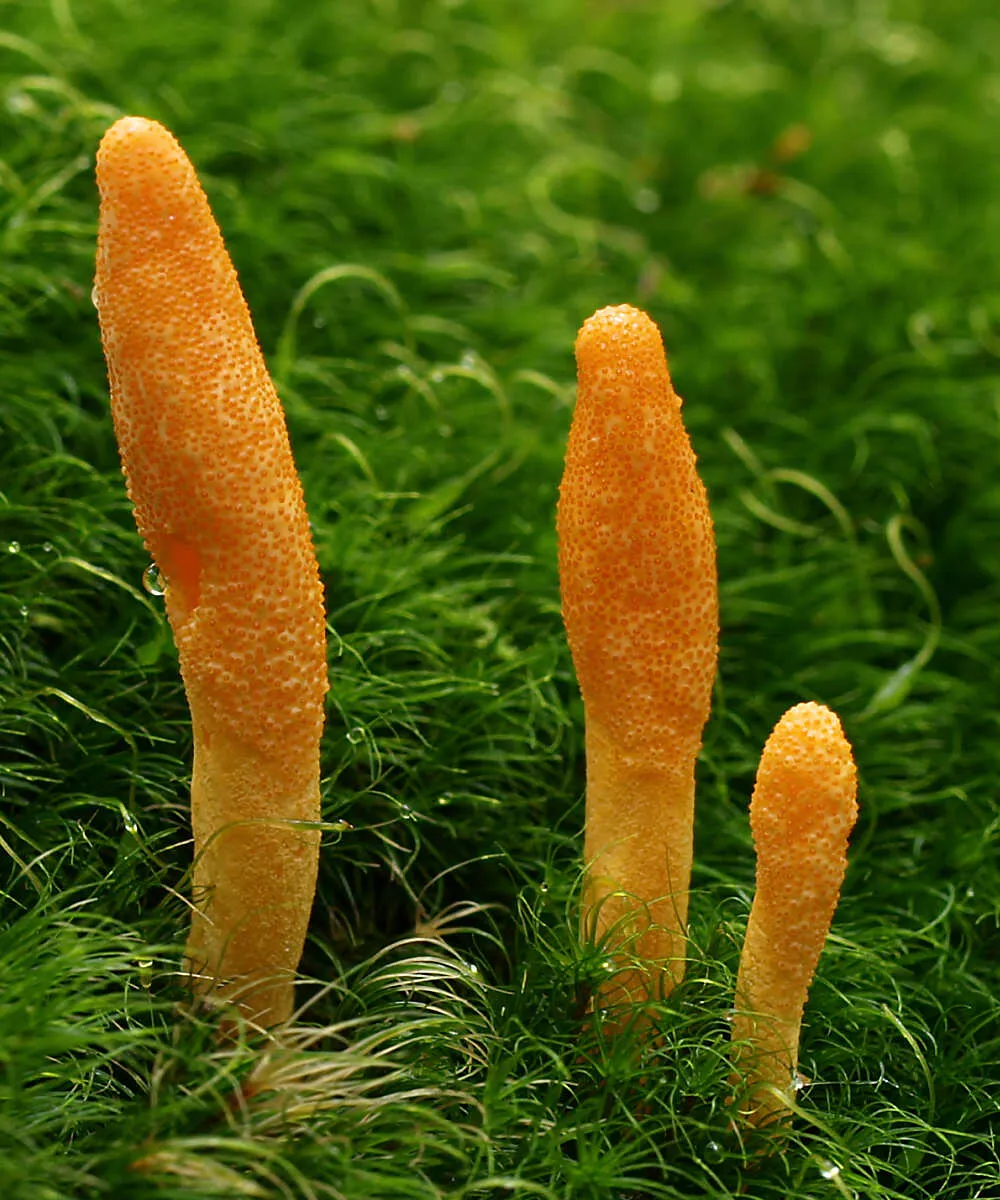 Photo: Andreas Kunze, CC BY-SA 3.0, via Wikimedia Commons
Cordyceps is taken as a powder, capsule or extract, and human trials have used about 1–4 g a day. The species and strain on the label determine which of those trials, if any, apply to a given product.
Species and form: Most evidence involves either Cs-4 fermented mycelium (sold as C. sinensis but classified as Paecilomyces hepiali; the most extensively studied commercial form) or C. militaris whole fruiting body powder or extract.
Doses studied: Commercial product doses vary widely and are not standardized. Human trials have used about 1 g/day of Cs-4 (Chen et al., 2010), 3 g/day of Cs-4 (Parcell et al., 2004), 1.5 g/day of C. militaris (Kang et al., 2015), and 4 g/day of a C. militaris-containing blend (Hirsch et al., 2017).
Extraction: Hot-water extraction is standard for polysaccharide concentration. Cordycepin is water-soluble and is recovered industrially with hot water (Luo et al., 2020), so it does not require ethanol (dual) extraction. Products that list only polysaccharide content say nothing about cordycepin.
Standardization: Reputable C. militaris extracts should specify cordycepin content and beta-glucan content; unextracted C. militaris fruiting bodies have been reported at roughly 2–3 mg/g (about 0.2–0.3%) cordycepin, with wide variation (Lo et al., 2013). O. sinensis standardization is inconsistent given the heterogeneity of the species and wild-harvest variability.
Timing: Human exercise studies have used supplementation periods of 1–12 weeks; acute single-dose effects are not established.
For how the cordyceps exercise trials compare with research on other functional mushrooms, see the medicinal mushrooms research overview. Cordyceps also appears in many mushroom coffee blends, usually at a fraction of trial doses; our mushroom coffee rankings compare the amounts each product discloses.
Safety, Interactions, and Contraindications
Human safety data come from small, short trials; in a 4-week RCT of 1.5 g/day C. militaris in 79 men, no significant adverse reactions were reported (Kang et al., 2015). Long-term safety has not been established. The following considerations apply:
Immunosuppressant interactions: Cordyceps has both immune-stimulating and immunosuppressive effects in laboratory studies, and in China O. sinensis preparations have been trialed in kidney transplant recipients in place of azathioprine or alongside reduced-dose cyclosporine (low-quality evidence; Hong et al., 2015). Its net effect on immunosuppressant therapy is uncertain, so organ transplant recipients should not use cordyceps without transplant team approval.
Anticoagulant and antiplatelet interactions: Cordycepin inhibited human platelet aggregation in vitro (Cho et al., 2006). The clinical significance in humans taking anticoagulants is unknown, but caution is warranted.
Autoimmune conditions: As with other immunomodulatory fungi, cordyceps should be used cautiously by people with autoimmune diseases (lupus, rheumatoid arthritis, multiple sclerosis).
Blood glucose-lowering medications: Given animal evidence of hypoglycemic effects, concurrent use with insulin or oral antidiabetics may require blood glucose monitoring.
Pregnancy and lactation: Insufficient safety data; avoid use.
Lead contamination risk: Taiwanese health officials reported two cases of lead poisoning in people taking cordyceps powder that contained up to 20,000 ppm lead (Wu et al., 1996); adulteration of high-priced O. sinensis is a recognized concern. Third-party CoA for heavy metals is essential for any O. sinensis product.
Product Selection Criteria
Species transparency: The product label should clearly state whether it contains C. militaris (cultivated), wild O. sinensis, or a fermented mycelium strain such as Cs-4 (Paecilomyces hepiali). Generic “cordyceps” labeling obscures important differences.
Fruiting body vs. mycelium: Cordycepin content varies with strain, substrate, and whether the product is fruiting body or mycelium; cultured O. sinensis mycelium had no detectable cordycepin in one analysis (Yang et al., 2009). Some manufacturers sell grain-cultured mycelium products that may contain significant starch from the substrate; look for a beta-glucan percentage (not just total polysaccharides) and, for C. militaris, a declared cordycepin content.
Cs-4 designation: Among fermented mycelium products sold as cordyceps, the Cs-4 strain has the most human clinical trial data and should be specified on the label if this form is intended.
Third-party testing: For O. sinensis specifically, independent testing for heavy metals (particularly lead) is essential. Seek ISO-accredited laboratory CoAs for identity verification, heavy metals, microbial contamination, and pesticide residues.
USDA Organic certification: Relevant for cultivated C. militaris products to minimize pesticide exposure in the grain substrate.
Frequently Asked Questions
What is cordyceps?
Cordyceps is a group of fungi that parasitize insect larvae. The traditional species, Ophiocordyceps sinensis, grows on ghost moth larvae on the Tibetan Plateau and a 2013 review put its price at USD 20,000–40,000 per kilogram (Lo et al., 2013). Most supplements use cultivated Cordyceps militaris or the fermented mycelium strain Cs-4 instead.
Does cordyceps work?
The evidence is mixed. A 12-week trial in 20 older adults found Cs-4 raised metabolic and ventilatory thresholds without changing VO2 max (Chen et al., 2010), while 3 g a day for 5 weeks did not improve performance in 22 trained cyclists. Kidney-disease trials reported favorable markers but were of low quality. Where effects appear, they are modest.
How much cordyceps should you take daily?
There is no established dose. Human trials have used about 1 g a day of Cs-4, 3 g a day of Cs-4, 1.5 g a day of C. militaris (Kang et al., 2015) and 4 g a day of a blend containing C. militaris, for 1 to 12 weeks. Product doses are not standardized, and anyone on medication should talk to a clinician first.
Is cordyceps safe?
Short trials have reported few problems; a 4-week trial of 1.5 g a day in 79 men found no significant adverse reactions. Long-term safety is unknown. Transplant recipients, people with autoimmune disease and those on blood thinners or diabetes drugs need clinician approval, and two lead-poisoning cases were traced to contaminated cordyceps powder (Wu et al., 1996).
Cordyceps vs lion’s mane: what is the difference?
They are studied for different goals. Cordyceps research focuses on exercise capacity, energy and kidney markers, linked to cordycepin and adenosine. Lion’s mane is studied for memory and mood, linked to compounds that induced nerve growth factor in lab studies. Human evidence for each is limited to small trials.
References
Show all 17 referencesShow fewer
- Chen, S., Li, Z., Krochmal, R., et al. (2010). Effect of Cs-4 (Cordyceps sinensis) on exercise performance in healthy older subjects. Journal of Alternative and Complementary Medicine, 16(5), 585–590.
- Hirsch, K. R., Smith-Ryan, A. E., Roelofs, E. J., et al. (2017). Cordyceps militaris improves tolerance to high-intensity exercise after acute and chronic supplementation. Journal of Dietary Supplements, 14(1), 42–53.
- Panda, A. K., & Swain, K. C. (2011). Traditional uses and medicinal potential of Cordyceps sinensis of Sikkim. Journal of Ayurveda and Integrative Medicine, 2(1), 9–13.
- Zhang, H. W., Lin, Z. X., Tung, Y. S., et al. (2014). Cordyceps sinensis (a traditional Chinese medicine) for treating chronic kidney disease. Cochrane Database of Systematic Reviews, (12), CD008353.
- Tuli, H. S., Sandhu, S. S., & Sharma, A. K. (2014). Pharmacological and therapeutic potential of Cordyceps with special reference to cordycepin. 3 Biotech, 4(1), 1–12.
- Parcell, A. C., Smith, J. M., Schulthies, S. S., Myrer, J. W., & Fellingham, G. (2004). Cordyceps sinensis (CordyMax Cs-4) supplementation does not improve endurance exercise performance. International Journal of Sport Nutrition and Exercise Metabolism, 14(2), 236–242.
- Lo, H. C., Hsieh, C., Lin, F. Y., & Hsu, T. H. (2013). A systematic review of the mysterious caterpillar fungus Ophiocordyceps sinensis in DongChongXiaCao and related bioactive ingredients. Journal of Traditional and Complementary Medicine, 3(1), 16–32.
- Kang, H. J., Baik, H. W., Kim, S. J., et al. (2015). Cordyceps militaris enhances cell-mediated immunity in healthy Korean men. Journal of Medicinal Food, 18(10), 1164–1172.
- Wu, T. N., Yang, K. C., Wang, C. M., et al. (1996). Lead poisoning caused by contaminated Cordyceps, a Chinese herbal medicine: two case reports. Science of the Total Environment, 182(1–3), 193–195.
- Olarte, R. A., Menke, J., Zhang, Y., et al. (2019). Chromosome rearrangements shape the diversification of secondary metabolism in the cyclosporin producing fungus Tolypocladium inflatum. BMC Genomics, 20(1), 120.
- Dong, C., Guo, S., Wang, W., & Liu, X. (2015). Cordyceps industry in China. Mycology, 6(2), 121–129.
- Hong, T., Zhang, M., & Fan, J. (2015). Cordyceps sinensis (a traditional Chinese medicine) for kidney transplant recipients. Cochrane Database of Systematic Reviews, (10), CD009698.
- Cho, H. J., Cho, J. Y., Rhee, M. H., Lim, C. R., & Park, H. J. (2006). Cordycepin (3’-deoxyadenosine) inhibits human platelet aggregation induced by U46619, a TXA2 analogue. Journal of Pharmacy and Pharmacology, 58(12), 1677–1682.
- Yang, F. Q., Ge, L., Yong, J. W., Tan, S. N., & Li, S. P. (2009). Determination of nucleosides and nucleobases in different species of Cordyceps by capillary electrophoresis-mass spectrometry. Journal of Pharmaceutical and Biomedical Analysis, 50(3), 307–314.
- Zhong, L., Zhao, L., Yang, F., et al. (2017). Evaluation of anti-fatigue property of the extruded product of cereal grains mixed with Cordyceps militaris on mice. Journal of the International Society of Sports Nutrition, 14, 15.
- Dong, Y., Jing, T., Meng, Q., et al. (2014). Studies on the antidiabetic activities of Cordyceps militaris extract in diet-streptozotocin-induced diabetic Sprague-Dawley rats. BioMed Research International, 2014, 160980.
- Luo, Q. Y., Cao, H. F., Liu, S. K., et al. (2020). Novel liquid fermentation medium of Cordyceps militaris and optimization of hydrothermal reflux extraction of cordycepin. Journal of Asian Natural Products Research, 22(2), 167–178.
Related content
More in Medicinal Mushrooms
- Chaga Mushroom (Inonotus obliquus)
Chaga benefits examined: what lab and animal studies show for antioxidant and immune effects, why human data are missing, and its oxalate kidney risk.
- Edible Mushrooms
Mushrooms benefits and nutrition: what button, cremini, oyster and shiitake supply, from ergothioneine to vitamin D2, what studies show, and side effects.
- Lion's Mane Mushroom (Hericium erinaceus)
Lion's mane benefits explained: what small human trials show for memory and mood, how hericenones and erinacines work, typical doses and side effects.
- Maitake Mushroom (Grifola frondosa)
Maitake mushroom benefits for immunity and blood sugar, weighed against mostly animal research; plus nutrition, D-fraction extracts and drug interactions.
- Reishi Mushroom (Ganoderma lingzhi)
Reishi benefits for immunity, fatigue and sleep, weighed against the trials; plus doses studied, side effects such as liver injury, and drug interactions.
- Shiitake Mushroom (Lentinula edodes)
Shiitake mushrooms benefits for immunity, cholesterol and vitamin D, checked against human trials; plus nutrition, daily amounts and shiitake dermatitis.

Browse all medicinal mushrooms →
Curated by Superfoods Advisor Editors·Last updated