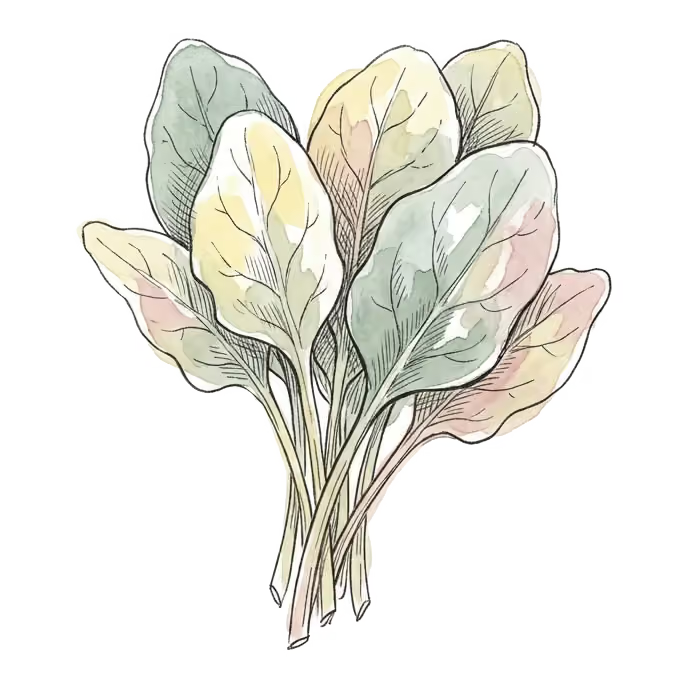
Spinach (Spinacia oleracea)
Spinacia oleracea · also known as common spinach, garden spinach, Persian herb
By Superfoods Advisor Editors·July 3, 2026
Is spinach good for you? Spinach nutrition per 100 g, nitrate and blood pressure, eye and brain research, oxalate and iron facts, and how much is too much.
Spinach (Spinacia oleracea) is a leafy green in the amaranth family (Amaranthaceae), not a cruciferous vegetable. It is good for you as a low-calorie source of vitamin K, folate and nitrate: 100 g raw has 23 kcal, 483 µg of vitamin K and 194 µg of folate. Its high oxalate content, though, means little of its calcium is absorbed.
Spinach originated in ancient Persia (present-day Iran), reached China around the 7th century CE, and arrived in Europe through Arab traders by the 11th century. Its tolerance of cool climates and fast growth likely helped it spread.
Today it is grown commercially in China, the United States, Turkey, Japan and across Europe, and eaten fresh, frozen, canned and in processed foods. Its “superfood” reputation has prompted plenty of research, though many popular health claims outpace the human evidence.
Evidence at a glance
Active Compounds
Spinach contains a broad spectrum of micronutrients and phytochemicals, several of which interact in ways relevant to bioavailability:
Nitrates: Spinach is a high-nitrate vegetable, though levels vary widely with cultivar, season, and growing conditions; a survey of retail leafy greens in the Canary Islands found a median of about 104 mg per 100 g in spinach (Martín León & Luzardo, 2020). Dietary nitrates are reduced to nitrite by oral bacteria and subsequently converted to nitric oxide (NO) in the stomach, blood, and tissues, a route that does not depend on nitric oxide synthase (Lundberg et al., 2008); NO contributes to vasodilation. This pathway underlies interest in spinach for cardiovascular and exercise performance applications.
Lutein and zeaxanthin: Carotenoids concentrated in spinach that accumulate selectively in the macular region of the retina. They are not converted to vitamin A but function as optical filters and antioxidants in ocular tissue. Carotenoid absorption from a spinach-containing salad was much greater with a full-fat dressing than with a fat-free one in a small crossover study (Brown et al., 2004; n = 7).
Glycoglycerolipids (MGDG, DGDG, SQDG): Membrane lipids in chloroplast thylakoids. Purified MGDG and SQDG from spinach inhibit mammalian DNA polymerases and cancer cell growth in laboratory and animal studies, while DGDG does not inhibit the polymerases (Maeda et al., 2011); clinical relevance is not established.
Oxalic acid (oxalate): Spinach contains among the highest oxalate concentrations of any commonly consumed vegetable (approximately 1,100 mg per 100 g raw; Chai & Liebman, 2005). Oxalic acid forms insoluble complexes with calcium in the gastrointestinal tract, markedly reducing calcium absorption from spinach itself. Its effect on iron appears smaller than often assumed: a stable-isotope study (Bonsmann et al., 2008; n = 16 women) found that adding oxalic acid to a kale meal did not change non-heme iron absorption, and iron absorption from a spinach meal was not significantly lower than from kale. Calcium absorption from spinach averaged about 5% in an isotope study (Heaney et al., 1988), against about 41% from low-oxalate kale (Heaney & Weaver, 1990). Across nine vegetables tested, boiling cut soluble oxalate by 30–87% and steaming by 5–53%, with the lost oxalate recovered in the cooking water, so discarding that water matters (Chai & Liebman, 2005).
Folate (vitamin B9): Spinach is one of the richer dietary sources of natural folate (194 µg per 100 g raw; USDA FoodData Central). As with other food folate, it is less bioavailable than synthetic folic acid.
Nutritional Profile
Values for raw spinach per 100 g edible portion (USDA FoodData Central, SR Legacy 168462):
| Nutrient | Amount | % DV |
|---|---|---|
| Energy | 23 kcal | — |
| Protein | 2.9 g | — |
| Total fat | 0.4 g | — |
| Carbohydrates | 3.6 g | — |
| Dietary fiber | 2.2 g | — |
| Vitamin K | 483 µg | 403% |
| Folate | 194 µg | 49% |
| Vitamin A (RAE) | 469 µg | 52% |
| Vitamin C | 28.1 mg | 31% |
| Iron | 2.7 mg* | 15% |
| Calcium | 99 mg* | 8% |
| Magnesium | 79 mg | 19% |
| Potassium | 558 mg | 12% |
*Actual absorbed calcium from spinach is considerably lower than this value suggests because of oxalate binding. Its non-heme iron is also poorly absorbed, though oxalate appears to play a smaller role in that than often assumed (see Active Compounds above).
Evidence for Purported Benefits
Cardiovascular Function and Blood Pressure
Evidence:Limited Nitrate trials mostly used beetroot or nitrate salts; spinach trials are small and short, and results conflict.
Dietary nitrates in spinach and other vegetables are converted to nitric oxide, a signaling molecule that induces smooth muscle relaxation and vasodilation. A 2013 meta-analysis of 16 short crossover trials (Siervo et al., 2013) found that inorganic nitrate or beetroot juice lowered systolic blood pressure by about 4.4 mmHg; most trials used beetroot juice or nitrate salts rather than spinach. In 26 healthy adults, a single meal providing 220 mg of nitrate from spinach lowered systolic blood pressure over the following hours (Liu et al., 2013). A week of eating more nitrate-rich leafy greens, however, did not change blood pressure in 38 adults with high-normal readings (Bondonno et al., 2014), so whether the acute effect persists with habitual intake is unclear.
Macular Health
Evidence:Preliminary No trials of spinach itself; the AREDS2 lutein and zeaxanthin supplement trial missed its primary outcome.
The Age-Related Eye Disease Study 2 (AREDS2 Research Group, 2013) evaluated lutein and zeaxanthin supplementation in 4,203 participants with intermediate age-related macular degeneration (AMD). Adding 10 mg lutein / 2 mg zeaxanthin to the AREDS formula did not significantly reduce progression to advanced AMD in the primary analysis; exploratory secondary analyses suggested a possible benefit in participants with the lowest dietary lutein/zeaxanthin intake. Spinach is among the most accessible dietary sources of these carotenoids, though causal inference from food sources specifically requires further study.
Cognitive Function
Evidence:Preliminary One 960-person cohort study of leafy greens as a group; observational, so confounding is possible.
A prospective cohort study (Morris et al., 2018) of 960 older adults followed for a mean 4.7 years found that those in the highest quintile of leafy-green intake (median about 1.3 servings a day) had slower cognitive decline, equivalent to being about 11 years younger, than those in the lowest. Spinach was among the leafy greens assessed. Confounding factors cannot be ruled out in observational designs.
Weight Management and Appetite
Evidence:Preliminary A single 38-woman randomized trial of a concentrated spinach thylakoid extract, not whole spinach.
The thylakoid membrane fraction of spinach has been investigated for its ability to slow fat digestion and promote satiety signals. A randomized, placebo-controlled trial (Montelius et al., 2014) in 38 overweight women found that 5 g of spinach thylakoid extract taken daily before breakfast for 12 weeks produced greater weight loss than placebo (5.0 vs 3.5 kg), increased postprandial GLP-1 release, and reduced the urge for sweet and chocolate foods. These results are intriguing but require replication in larger, diverse populations.
Typical Use and Preparation
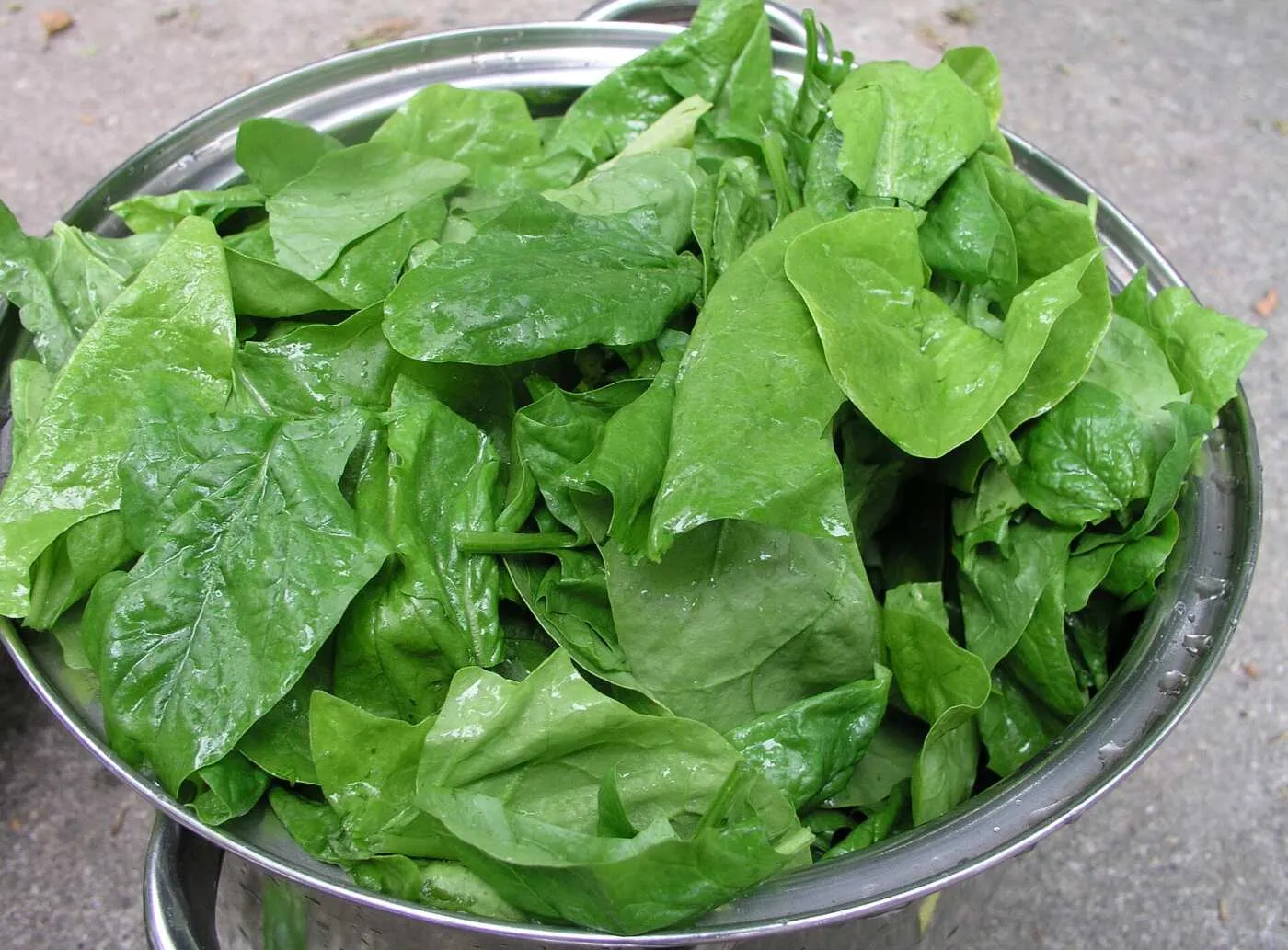 Photo: Nillerdk, CC BY 3.0, via Wikimedia Commons
Spinach is consumed raw in salads and smoothies, or cooked by steaming, sautéing, blanching, or incorporating into soups, pasta, and egg dishes. Cooking reduces vitamin C, folate, and oxalate content. Breaking down the leaf structure raises the bioavailability of beta-carotene; in one human trial, enzymatically liquefied spinach roughly doubled beta-carotene bioavailability compared with whole leaves but did not change lutein bioavailability (Castenmiller et al., 1999). Pairing cooked spinach with a fat source (olive oil, nuts) further enhances carotenoid absorption.
For individuals concerned about iron intake, consuming spinach alongside vitamin C-rich foods can improve absorption of its non-heme iron by keeping iron in the more absorbable ferrous (Fe²⁺) form. However, low-oxalate leafy greens such as kale and bok choy remain superior sources of bioavailable calcium.
In a comparison of four vitamins across eight fruits and vegetables including spinach, frozen produce was generally comparable to fresh refrigerated produce, although frozen spinach was lower in beta-carotene in one of two sample sets (Bouzari et al., 2015). Canning’s initial heat treatment causes losses of vitamin C and B vitamins, which then stay relatively stable during storage in the can (Rickman et al., 2007).
Baby spinach is one of the greens in the superfood salad bowl recipe. Its nitrate content puts it alongside arugula and beets in the guide to heart health superfoods.
Safety, Interactions, and Contraindications
Vitamin K and anticoagulants: Spinach is exceptionally high in vitamin K₁ (phylloquinone), a cofactor for clotting factor synthesis. Individuals taking warfarin (Coumadin) or other vitamin K-antagonist anticoagulants are advised to keep their dietary vitamin K intake consistent rather than avoid it. Very large or sudden increases in vitamin K intake can counteract warfarin, lowering INR and raising clotting risk, and wide fluctuations in either direction can destabilize anticoagulation (Linus Pauling Institute). A systematic review found the evidence on dietary vitamin K and INR conflicting and concluded that avoiding wide swings in intake matters more than restriction (Violi et al., 2016). Patients on these medications should not substantially alter their leafy green intake without notifying their anticoagulation clinician.
Kidney stones (oxalate): Individuals with a history of calcium oxalate kidney stones — the most common kidney stone type — are typically advised by urologists to limit high-oxalate foods including spinach. In controlled feeding studies, urinary oxalate excretion rose as dietary oxalate rose, and lowering dietary calcium increased it further because calcium binds oxalate in the gut (Holmes et al., 2001). Adequate hydration and sufficient dietary calcium are standard components of dietary management for oxalate stone formers.
Hyperkalemia risk: Spinach’s high potassium content (558 mg/100 g raw, per USDA FoodData Central) may be relevant for individuals with chronic kidney disease or those taking potassium-sparing diuretics or ACE inhibitors, who may need to moderate intake per clinical guidance.
This content is for educational purposes only and does not constitute medical advice, diagnosis, or treatment. Consult a qualified healthcare provider before making changes to your diet or supplement regimen.
Frequently Asked Questions
Is spinach a superfood?
“Superfood” is a marketing term with no legal definition, but spinach delivers a lot per calorie: 100 g raw has 23 kcal, 483 µg of vitamin K, 194 µg of folate and 79 mg of magnesium. Its best-supported benefit is short-term: in a small trial, a nitrate-rich spinach meal lowered systolic blood pressure over the following hours. The limit is that a week of extra leafy greens did not change blood pressure, and its eye and brain links are untested or observational. Kidney-stone formers should also mind its oxalate.
Is spinach good for you?
For most people, yes. Spinach is low in energy, 23 kcal per 100 g raw, and supplies 483 µg of vitamin K, 194 µg of folate, 469 µg of vitamin A and 79 mg of magnesium. Research on its nitrate, lutein and leafy-green intake is promising but mostly short-term or observational. The main caveats are oxalate for kidney-stone formers and vitamin K for people on warfarin.
What is spinach high in?
Per 100 g raw, spinach is especially high in vitamin K (483 µg, over 400% of the daily value), vitamin A (469 µg RAE), folate (194 µg) and potassium (558 mg). It is also a high-nitrate vegetable and a rich source of lutein and zeaxanthin. It is high in oxalate too, about 1,100 mg per 100 g, which lowers how much of its calcium the body absorbs.
Is spinach high in fiber?
Moderately. Raw spinach has about 2.2 g of dietary fiber per 100 g, according to USDA FoodData Central. Because cooked spinach shrinks a great deal, a cooked portion packs in more leaves, and more fiber, than the same volume raw. Kale and collard greens are higher, at about 4 g per 100 g raw.
How much spinach is too much?
No upper limit is set for healthy adults, but three groups have reasons to watch amounts. People with calcium oxalate kidney stones are often advised to limit high-oxalate foods such as spinach. People on warfarin should keep vitamin K intake consistent rather than swing between large and small amounts. Those with chronic kidney disease may need to moderate potassium. A clinician can set limits for each case.
Does spinach have iron?
Spinach lists 2.7 mg of iron per 100 g raw, but it is non-heme iron and is poorly absorbed. Oxalate seems to play a smaller part in this than often assumed: in a 16-woman isotope study, iron absorption from spinach was not significantly lower than from kale. Eating spinach with vitamin C-rich foods can help absorption of its non-heme iron.
Spinach vs Swiss chard: what is the difference?
Both belong to the amaranth family and both are high in oxalate, so neither is a good calcium source. Spinach is notably high in folate, at 194 µg per 100 g raw. Swiss chard is a variety of beet grown for its leaves and colored stalks. For well-absorbed calcium, low-oxalate greens such as kale and bok choy work better.
References
Show all 21 referencesShow fewer
- Siervo, M., Lara, J., Ogbonmwan, I., & Mathers, J. C. (2013). Inorganic nitrate and beetroot juice supplementation reduces blood pressure in adults: A systematic review and meta-analysis. Journal of Nutrition, 143(6), 818–826.
- Liu, A. H., Bondonno, C. P., Croft, K. D., et al. (2013). Effects of a nitrate-rich meal on arterial stiffness and blood pressure in healthy volunteers. Nitric Oxide, 35, 123–130.
- Bondonno, C. P., Liu, A. H., Croft, K. D., et al. (2014). Short-term effects of nitrate-rich green leafy vegetables on blood pressure and arterial stiffness in individuals with high-normal blood pressure. Free Radical Biology and Medicine, 77, 353–362.
- Age-Related Eye Disease Study 2 Research Group (AREDS2). (2013). Lutein + zeaxanthin and omega-3 fatty acids for age-related macular degeneration. JAMA, 309(19), 2005–2015.
- Morris, M. C., Wang, Y., Barnes, L. L., Bennett, D. A., Dawson-Hughes, B., & Booth, S. L. (2018). Nutrients and bioactives in green leafy vegetables and cognitive decline: Prospective study. Neurology, 90(3), e214–e222.
- Montelius, C., Erlandsson, D., Vitija, E., Stenblom, E. L., Egecioglu, E., & Erlanson-Albertsson, C. (2014). Body weight loss, reduced urge for palatable food and increased release of GLP-1 through daily supplementation with green-plant membranes for three months in overweight women. Appetite, 81, 295–304.
- Bonsmann, S. S., Walczyk, T., Renggli, S., & Hurrell, R. F. (2008). Oxalic acid does not influence nonhaem iron absorption in humans: a comparison of kale and spinach meals. European Journal of Clinical Nutrition, 62(3), 336–341.
- Chai, W., & Liebman, M. (2005). Effect of different cooking methods on vegetable oxalate content. Journal of Agricultural and Food Chemistry, 53(8), 3027–3030.
- Heaney, R. P., Weaver, C. M., & Recker, R. R. (1988). Calcium absorbability from spinach. American Journal of Clinical Nutrition, 47(4), 707–709.
- Heaney, R. P., & Weaver, C. M. (1990). Calcium absorption from kale. American Journal of Clinical Nutrition, 51(4), 656–657.
- Martín León, V., & Luzardo, O. P. (2020). Evaluation of nitrate contents in regulated and non-regulated leafy vegetables of high consumption in the Canary Islands, Spain: Risk assessment. Food and Chemical Toxicology, 146, 111812.
- USDA FoodData Central. Spinach, raw (FDC ID 168462).
- Lundberg, J. O., Weitzberg, E., & Gladwin, M. T. (2008). The nitrate-nitrite-nitric oxide pathway in physiology and therapeutics. Nature Reviews Drug Discovery, 7(2), 156–167.
- Brown, M. J., et al. (2004). Carotenoid bioavailability is higher from salads ingested with full-fat than with fat-reduced salad dressings as measured with electrochemical detection. American Journal of Clinical Nutrition, 80(2), 396–403.
- Maeda, N., Matsubara, K., Yoshida, H., & Mizushina, Y. (2011). Anti-cancer effect of spinach glycoglycerolipids as angiogenesis inhibitors based on the selective inhibition of DNA polymerase activity. Mini-Reviews in Medicinal Chemistry, 11(1), 32–38.
- Castenmiller, J. J., West, C. E., Linssen, J. P., van het Hof, K. H., & Voragen, A. G. (1999). The food matrix of spinach is a limiting factor in determining the bioavailability of beta-carotene and to a lesser extent of lutein in humans. Journal of Nutrition, 129(2), 349–355.
- Bouzari, A., Holstege, D., & Barrett, D. M. (2015). Vitamin retention in eight fruits and vegetables: a comparison of refrigerated and frozen storage. Journal of Agricultural and Food Chemistry, 63(3), 957–962.
- Rickman, J. C., Barrett, D. M., & Bruhn, C. M. (2007). Nutritional comparison of fresh, frozen and canned fruits and vegetables. Part 1. Vitamins C and B and phenolic compounds. Journal of the Science of Food and Agriculture, 87(6), 930–944.
- Violi, F., Lip, G. Y., Pignatelli, P., & Pastori, D. (2016). Interaction between dietary vitamin K intake and anticoagulation by vitamin K antagonists: is it really true? A systematic review. Medicine (Baltimore), 95(10), e2895.
- Holmes, R. P., Goodman, H. O., & Assimos, D. G. (2001). Contribution of dietary oxalate to urinary oxalate excretion. Kidney International, 59(1), 270–276.
- Linus Pauling Institute Micronutrient Information Center. Vitamin K.
Related content

More in Leafy Greens
- Arugula (Eruca vesicaria ssp. sativa)
Is arugula good for you? Nutrition per 100 g, nitrate and blood pressure, vitamin K, cancer research and safety for this peppery cruciferous green.
- Barley Grass (Hordeum vulgare)
Barley grass benefits weighed against the evidence: antioxidant and blood sugar research, whether it contains gluten, vitamin K, dosing and safety.
- Bok Choy (Brassica rapa subsp. chinensis)
Bok choy benefits and nutrition: well-absorbed calcium, vitamin C and K per 100 g, glucosinolates, the raw-intake thyroid caveat, and how to cook it.
- Broccoli Sprouts (Brassica oleracea var. italica sprouts)
Broccoli sprouts benefits: why 3-day sprouts carry 10–100x more glucoraphanin than broccoli, what human trials found, how to eat them, and sprout safety.
- Collard Greens (Brassica oleracea var. viridis)
Health benefits of collard greens: vitamin K, calcium and fiber per 100 g, what research shows for bones and heart, cooking tips, and warfarin cautions.
- Kale (Brassica oleracea var. sabellica)
Is kale good for you? Kale nutrition per 100 g, what research shows for heart, eyes and bones, kale vs spinach, how much is too much, and safety.


Curated by Superfoods Advisor Editors·Last updated